
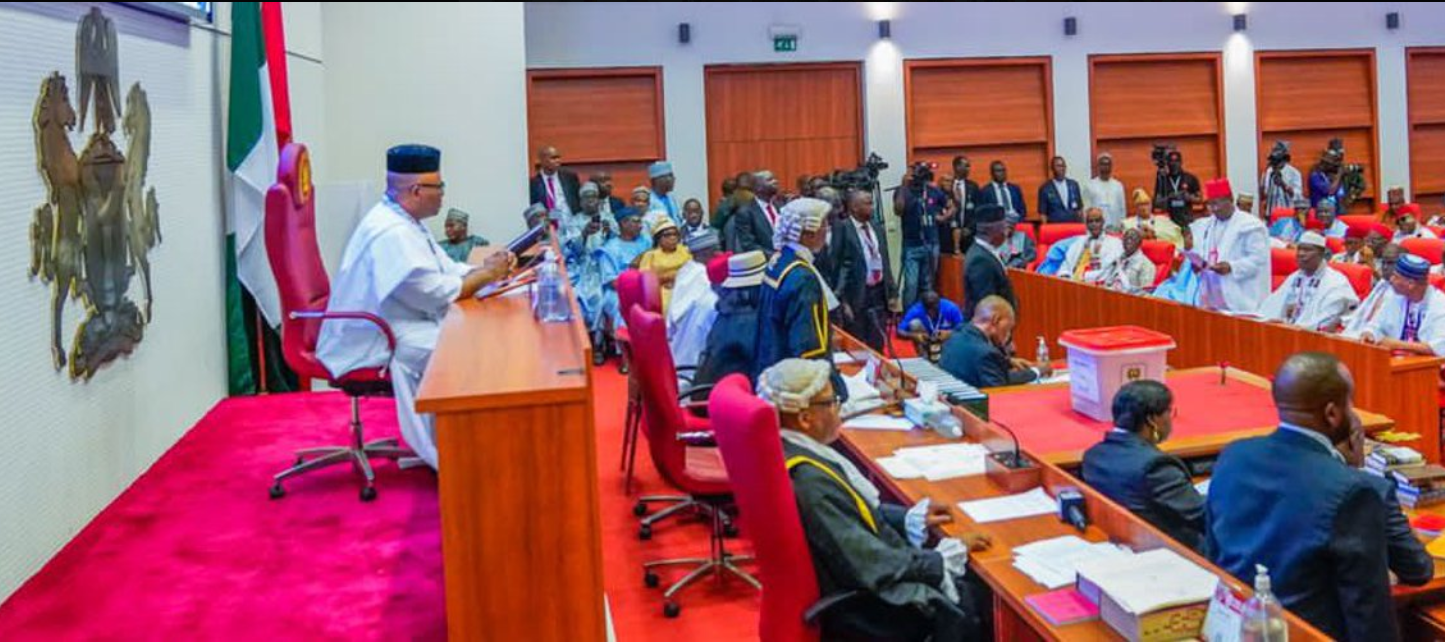
In 48 hours behind closed doors, seven senators decided that 200 million Nigerians don’t deserve to know if their votes were counted. Here’s what that decision costs – and why it proves Africa needs one electoral system, not 55 fragmented ones.
The Room Where It Happened
On January 29, 2026, the Nigerian Senate formally began deliberations on the Electoral Act (Repeal and Re-enactment) Bill, 2026, marking a significant move toward reforming the country’s electoral system.
Inside a closed-door session at Nigeria’s National Assembly, seven men are deciding the fate of 200 million people’s right to transparent elections.
The names matter: Senators Niyi Adegbomore, Adamu Aliero, Aminu Tambuwal, Adams Oshiomhole, Danjuma Goje, Tony Nwoye and Titus Zam. All beneficiaries of the current system.
Their task: “Harmonize” the Electoral Act Amendment Bill 2026.
Their decision: Electronic transmission of election results? Optional. Real-time uploading to a public portal? Unnecessary. Making sure every vote can be traced and verified? Too risky.
In two hours, they gutted the one reform that could have saved Nigerian democracy.
The Senate’s Sleight of Hand: What They Actually Did
The 2026 Electoral Bill had a simple provision buried in Clause 60(5): “INEC shall transmit results of elections by electronic means in real-time from polling units to the IReV portal.” Clear. Unambiguous. Mandatory.
The House of Representatives passed it in February 2025. Civil society groups celebrated. International observers nodded in approval. Nigerian youth, who largely stayed home in 2023, started registering to vote again.
Then the bill went to the Senate.
The Seven-Man Committee
In January 2026, instead of voting on the House version, the Senate convened a “harmonization committee.” Seven senators. Closed session. No public record.
Two hours later, they emerged with their decision: Clause 60(5) rejected.
New language: “INEC may prescribe the manner of transmitting results.”
Translation: Electronic transmission is optional. INEC decides. If there are “technical issues,” manual collation is fine. Just like 2023.
The Other Casualties
While they were at it, the seven senators also:
1. Killed Clause 142 (The Evidence Rule)
What it said: In election disputes, parties can prove irregularities using only original or certified documents – no need for witnesses from every polling unit.
Why it mattered: Currently, to challenge an election in Nigeria, you need oral testimony from witnesses at thousands of polling units. Impossible for most candidates. Courts dismiss cases on technicalities.
The Senate’s reason for removing it: “Waste of time in court.”
The real reason: Makes it nearly impossible to successfully challenge rigged elections.
2. Restored “Super Delegates”
The backstory: The 2022 Electoral Act accidentally excluded current and former officeholders (governors, senators, ministers) from voting in party primaries. Parties had to use only “ad hoc delegates” – ordinary party members.
What this meant: Primary elections became slightly less elite-controlled. Fresh faces had a chance.
The 2026 Bill’s fix: Bring back the “super delegates.” Automatic voting rights for all current/former officeholders.
Translation: Party primaries will once again be auctions. The highest bidder (who can pay off the most super delegates) gets the ticket.
3. Rejected Digital Voter Cards
The proposal: Allow voters to download and print their voter cards. Why? Because BVAS (the biometric machines) don’t actually read the microchip in physical PVC – they just verify via fingerprint anyway.
The Senate’s decision: No. Physical PVC cards remain mandatory.
The impact: Millions of Nigerians who registered but couldn’t collect physical cards before election day remain disenfranchised.
Who this hurts most: Urban youth (high registration, low collection rates due to job conflicts with collection hours) and diaspora Nigerians.
The Counter-Argument: Why the Senate Says No
Argument 1: “Technical Glitches Are Real”
The Senate’s Position:
“What if the BVAS machines fail again? What if network coverage is poor in rural areas? We need flexibility for manual backup.”
The Response: Lessons from Kenya and Ghana
Kenya has rural areas too. Ghana has network issues too. They mandate e-transmission anyway and solve technical problems with:
- Satellite internet backup (Starlink, etc.)
- Offline mode that syncs when connectivity returns
- Redundant systems (multiple upload pathways)
- Severe penalties for electoral officers who don’t fix glitches quickly
The real question: Why invest in making technology work when you can just allow manual manipulation as a “backup”?
Argument 2: “We Need Time to Prepare”
The Senate’s Position:
“If we rush this bill, we’ll regret it at the tribunal. We need a thorough review.”
The Response:
The bill has been in review for 18 months. The House passed their version in February 2025. Civil society submitted detailed input in 2024.
Meanwhile:
- Kenya drafted and passed electoral reforms in 9 months before their 2022 election.
- Ghana implemented biometric voting in 6 months before 2012.
Nigeria’s Senate had 18 months. They’re not being careful. They’re stalling.
Argument 3: “This Protects Party Primaries”
The Senate’s Position:
“Super delegates ensure experienced leaders have a voice in choosing candidates.”
The Translation:
“Super delegates ensure we (current senators) control who gets nominated, guaranteeing our political survival.”
What Transparency Actually Looks Like – Kenya, August 2022
When Kenyans voted in the 2022 presidential election, something remarkable happened: Within 24 hours, over 90% of polling station results were uploaded to a public portal. Anyone with internet access could see the raw tallies – Form 34As, signed by party agents, uploaded as photos.
The presidential race was decided by less than 1%. Accusations of rigging flew. The losing candidate went to court.
Kenya’s Supreme Court reviewed 46,000 polling station result forms. All digitally available. All verifiable.
The court upheld the results. Peaceful transfer of power.
The difference between Kenya and Nigeria? One word: Mandatory.
Kenya’s electoral law requires real-time electronic transmission. Not suggested. Not “at the discretion of the commission.” Required.
The Nigeria Contrast
In Nigeria’s 2023 presidential election, there were 176,000 polling units. Results were supposed to be uploaded to the IReV portal (INEC Result Viewing Portal) in real-time.
What actually happened:
- Massive “technical glitches” on election day
- Results uploaded hours or days late
- In some areas, results never uploaded at all
- Manual collation allowed “for technical reasons”
- The final uploaded results didn’t match manual tallies in hundreds of polling units
The comparison:
| Metric | Kenya (2022) | Nigeria (2023) | The Gap |
| Results uploaded within 24 hours | 90%+ | <60% | Kenya: 50% more transparent |
| Legal mandate for e-transmission | Yes (mandatory) | No (discretionary) | Critical difference |
| Court petition resolution | 6 months | 18+ months (ongoing) | Kenya: 3x faster |
| Public trust in results | 67% (Afrobarometer) | 31% (NOI Polls) | Nigeria: Half the legitimacy |
| Voter turnout (next election) | 65% projected | 29% (2023 actual) | Apathy from lack of trust |
Translation: Kenyan voters have confidence that their ballots matter. In Nigeria, that confidence is steadily eroding.
Why? Because in Kenya, voters can verify that their votes were properly recorded. In Nigeria, citizens are asked to rely on trust alone.
The Price Tag of Rigged Elections
The cost of the Senate’s decision: $18 billion.
Not in one transaction. In a thousand small thefts. Every rigged election. Every court case that drags for years. Every young Nigerian who stops voting because “what’s the point?”
But here’s what makes this a continental story, not just a Nigerian one: This same script is playing in 54 other countries. Different actors. Same ending.
The Direct Costs (Annual)
| Cost Category | Amount (USD) | What This Buys |
| Endless Litigation (court costs, legal fees, tribunal operations for 18+ months post-election) | $450 million | 225 new secondary schools across Nigeria |
| Voter Apathy Tax (lost economic productivity when only 29% vote vs. 65% in healthier democracies) | $12.3 billion | Nigeria’s entire education budget for one year |
| Political Instability Premium (higher borrowing costs due to governance risk) | $3.8 billion | Universal healthcare for 50 million Nigerians |
| Brain Drain Acceleration (young professionals leaving due to political hopelessness) | $1.5 billion | Train 75,000 doctors and keep them home |
| TOTAL ANNUAL FRAGMENTATION TAX | $18.06 billion | Enough to eliminate poverty for 40 million Nigerians |
That $18 billion? That’s what Nigeria loses every year because elections aren’t credible.
The Continental Comparison
| Country | E-Transmission Mandate | Voter Turnout (Latest Election) | Election Litigation Duration | Public Trust in Electoral Commission |
| Kenya | ✅ Mandatory (law requires it) | 65% | 6 months average | 67% |
| Ghana | ✅ Mandatory | 68% | 8 months average | 61% |
| South Africa | ⚠️ Paper-based but transparent, independent oversight | 58% | 4 months average | 71% |
| Nigeria | ❌ Optional (INEC discretion) | 29% | 18+ months | 31% |
Pattern: Mandatory transparency = higher trust = higher turnout = faster dispute resolution.
Nigeria’s Senate just chose: Discretionary opacity = collapsing trust = voter apathy = endless litigation.
Proposition:
What If There Was One African Electoral Commission?
The African Electoral Commission (AEC)
Imagine if Africa had one electoral body – like the European Union has election standards that all 27 member states must meet.
How it would work:
1. Continental Standards (Non-Negotiable)
- All 55 African countries must use biometric verification.
- All must transmit results electronically in real-time.
- All must publish results at polling station level within 24 hours.
- All must resolve election disputes within 6 months?
2. The AEC Enforcement Mechanism
- Countries failing to meet standards face:
- Suspension from African Union voting rights.
- Loss of access to African Development Bank loans.
- Trade sanctions from other member states.
- International election observers report flagging the country.
3. Shared Technology Infrastructure
- One continental results transmission system (like Kenya’s KIEMS, but Africa-wide)
- One voter registration database (preventing multiple registrations across borders)
- One election security protocol (making hacking/manipulation exponentially harder)
4. Independent Oversight
- African Court of Justice reviews disputed elections
- No more “sovereignty” shield for electoral fraud
- Citizens can appeal to continental court if national courts fail
The Current Reality: 55 Broken Systems
Right now, Africa has 55 separate electoral systems. Each with different rules. Different technology. Different standards.
The result:
Nigeria: Optional e-transmission. Litigation takes years. 29% turnout.
Zimbabwe: Election results delayed for days. Opposition claims rigging. No credible resolution mechanism.
Uganda: Internet shut down on election day “for security.” Results announced by the electoral commission, declaring one of Africa’s longest-serving rulers the winner with 76.25 percent of the vote.
Kenya: Mandatory e-transmission works. 65% turnout. Disputes resolved in months.
Ghana: Transparent process. 68% turnout. Peaceful transfers of power.
Rwanda: Biometric voting. Clean results. But an authoritarian regime means elections aren’t competitive anyway.
The pattern: Fragmentation allows strongmen to game their local systems. Continental standards would force accountability.
The Human Cost: Stories on the Ground
Amina, 28, Lagos:
Amina registered to vote in 2023. First-time voter. Excited to participate.
Election day: She arrived at her polling unit at 8 AM. Voted by 10 AM. The BVAS machine worked fine – fingerprint verified, vote cast.
She checked the IReV portal that evening to confirm her polling unit results were uploaded.
Nothing.
Checked the next day. Nothing.
One week later, results finally appeared – but the numbers didn’t match what she and other voters had seen announced at the polling unit.
Her candidate lost by a margin smaller than the “adjusted” votes.
She filed a complaint. Never heard back.
Her conclusion: “My vote didn’t matter. Why should I vote again in 2027?”
Multiply Amina by 30 million young Nigerians. That’s why turnout collapsed to 29%.
A Member of the Seven-Man Committee: Senator Adams Oshiomhole, 72, Abuja
Adams Oshiomhole is on the seven-man harmonization committee. Former governor. Former labor union leader. Political survivor.
He knows elections. He’s won several.
In 2019, credible reports suggested his re-election as governor involved:
- Intimidation of opposition agents at collation centers
- Alteration of results after they left polling units
- Court battles that lasted until his term nearly ended
His position on mandatory e-transmission: “We must be realistic about technical capacity.”
Translation: “Manual collation gave me flexibility when I needed it. Why would I remove it when it can guarantee my re-election?”
The question remains: Why are the very people tasked with writing election laws also the ones who stand to benefit from election fraud? This conflict of interest lies at the heart of Nigeria’s electoral challenges.
The 2027 Countdown: What Happens Next
The bill now goes to final vote in the Senate (expected February-March 2026). Then to the House for reconciliation of the two versions. Then to President Bola Tinubu for signature.
Three possible outcomes:
Scenario 1: Senate Version Wins (70% Probability)
What happens:
- No mandatory e-transmission.
- Super delegates return.
- A high evidentiary bar for challenges remains.
- 2027 elections run like 2023.
The result:
- Turnout drops further (projected: 22-25%).
- Major opposition parties boycott, claiming the process is rigged before it starts.
- International observers issue damning reports.
- Post-election violence likely in disputed states.
- Whoever “wins” lacks legitimacy.
- Constitutional crisis by mid-2027.
The continental impact:
Nigeria’s failure emboldens autocrats across Africa. “If Nigeria can get away with it, so can we.”
Scenario 2: House Version Wins (20% Probability)
What happens:
- Mandatory e-transmission passes.
- Senate super delegates removed.
- Lower evidentiary bar for challenges.
The result:
- Turnout recovers (projected: 45-50%).
- Cleaner election process.
- Faster litigation resolution.
- Stronger democratic consolidation.
- Nigeria becomes a model (like Kenya post-2022 reforms);
The continental impact:
West Africa sees a democratic renewal. ECOWAS-wide electoral reforms follow. Coup risk declines.
Scenario 3: Constitutional Crisis (10% Probability)
What happens:
- President Tinubu refuses to sign either version.
- Bill goes back to the National Assembly.
- Deadlock extends past the legal deadline (one year before elections).
- 2027 elections held under 2022 Act (which everyone agrees is flawed).
The result:
- Complete loss of public confidence.
- Mass protests.
- Potential military intervention justified as “saving democracy”.
- West Africa’s coup contagion reaches Nigeria.
The Question Nigeria Must Answer
The Electoral Act Amendment Bill is not a technical document. It’s a choice.
The choice:
Do we want democracy, or do we want the appearance of democracy?
Do we want elections where every vote counts, or elections where the outcome is negotiated in backrooms before ballots are even cast?
Do we want to build a Federal States of Africa where rigging is impossible, or 55 fragmented banana republics where strongmen game their local systems?
Nigeria’s Senate has chosen: Appearance over substance. Elite control over popular will. 2027 will be 2023 with different dates.
But here’s the thing about unsustainable systems: they collapse.
The math doesn’t lie:
- 29% turnout in 2023
- Projected 22-25% in 2027
- At what percentage does the entire system lose legitimacy?
- 15%? 10%?
- And then what?
History shows that when electoral democracy repeatedly fails, public confidence in elections declines. When citizens lose trust in the process, two outcomes are often observed:
Option A: Military intervention
Justifications often cite the inability of civilian institutions to govern effectively.
Option B: Popular uprisings
Citizens may seek alternative means to make their voices heard when elections appear ineffective.
Both scenarios carry serious risks for stability and governance.
There is a third way: strengthen the system before it reaches a breaking point.
For Nigeria, this means: passing the House version of the bill, making e-transmission mandatory, removing super delegates, and lowering the evidentiary bar – measures that would help citizens trust that their votes matter.
For Africa, it means recognizing the limitations of 55 independent electoral systems and exploring a coordinated, federal approach: one set of standards, one technology backbone, and consistent mechanisms to ensure transparent and credible elections across the continent.
The only path to credible elections across Africa is a federal system:
- One set of standards
- One court of appeals
- One technology backbone
- One commitment to transparency
Fragmentation is not the same as diversity – it is a vulnerability. Electoral fragmentation, in particular, undermines democracy. Nigeria’s Senate has just demonstrated this in practice.
The pressing question for the continent is: Will Africa learn from Nigeria’s experience before 54 other countries repeat the same mistakes? Or will the region embrace a unified approach to credible elections?
Nigeria’s electoral crisis is not just a national issue; it is a continental one. The Senate’s decisions have implications for 1.4 billion Africans, setting a precedent – for better or worse – for the future of democracy across the continent.
Enefiok Udonkang
Correspondent, KAJARBI 54 – e.udonkang@kajarbi54.com



No Comments
Join the DiscussionBe the first to join the discussion!