
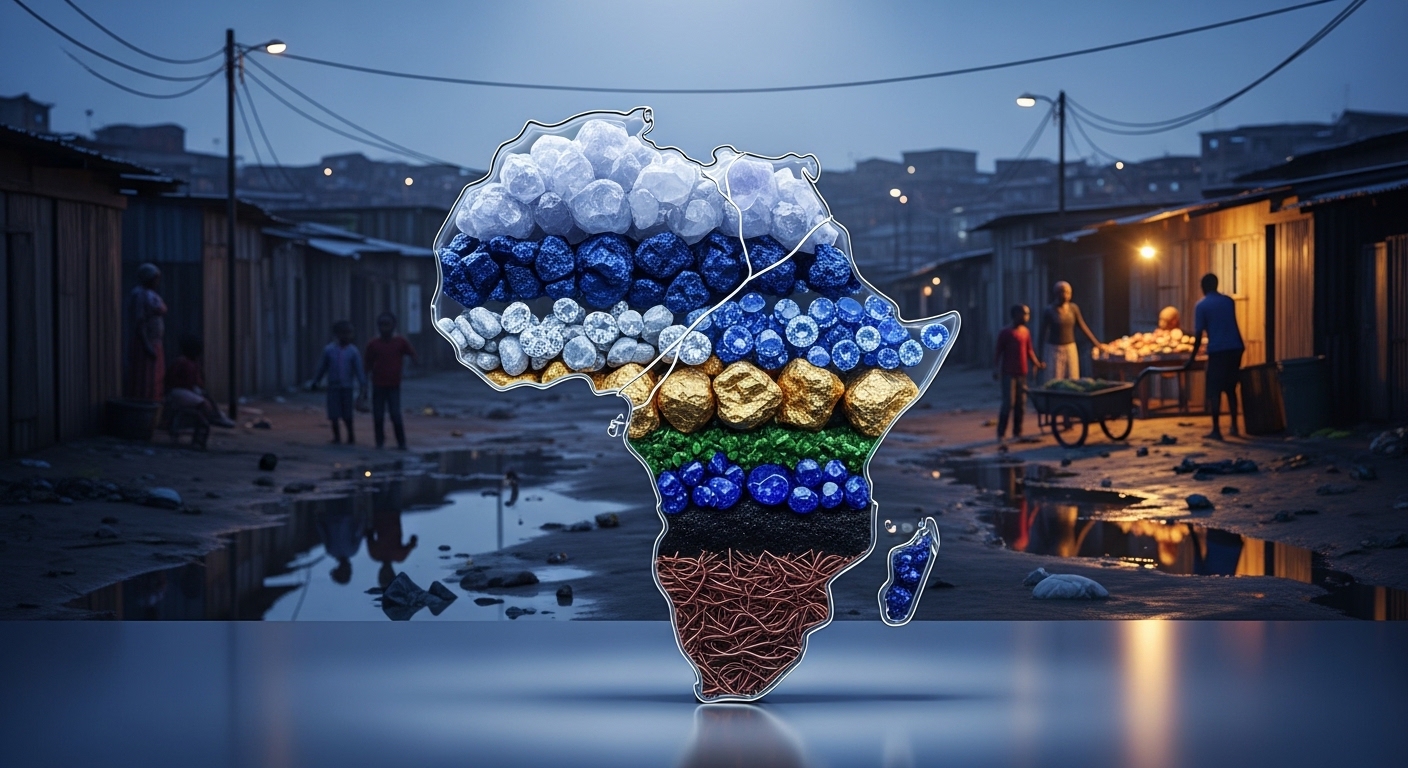
Africa is often portrayed as impoverished, underdeveloped, and perpetually struggling; a narrative that has persisted for decades despite the continent’s vast natural wealth and global contributions. A closer look reveals a striking paradox. Africa is rich in resources, still, the wealth it generates from these resources rarely translates into broad-based development.
As Dr David Okoror, Security and Governance Strategist at the International Institute for Security and Governance Studies in Nigeria, observed in an interview with Kajarbi54:
“Africa is not poor. Africa is wealthy – but it is badly governed, poorly protected, and strategically exploited. Although Africa’s problem is not foreign exploitation alone, it is foreign exploitation that is enabled by its leadership.”
According to the United Nations, Africa holds approximately 30 per cent of the world’s mineral reserves, 12 per cent of global oil, and 8 per cent of natural gas. The continent accounts for 40 per cent of global gold and up to 90 per cent of chromium and platinum. These resources power modern technology, sustain global supply chains, and generate enormous wealth; yet much of it flows beyond the continent’s borders.
These realities have shaped global perceptions of Africa, influenced the continent’s full participation in global institutions, and, ironically, left Africa’s vast natural wealth as a paradox – two sides of the same coin, where plenty exists alongside deprivation.
The Paradox of Scarcity Amid Abundance
If Africa’s resources are so abundant, why then is it often described as a scarcity plagued “third world” continent”?
Mr Tochukwu Ifemene, founder of the think tank Time and Chance, Nigeria, emphasises:
“Development is fundamentally rooted in economic structures and ideology; both of which remain underdeveloped across much of Africa. Identity formation has largely evolved along tribal lines, without being effectively transformed into a cohesive national ideology aimed at promoting the collective welfare of our people.”
Dr Okoror adds:
“We need a more transparent process for how people extract our natural resources. There must be an open contracting system, ensuring economic security and protecting pipelines and borders. As long as borders remain porous, all sorts of exploitation will occur. This is how we can escape the paradox of scarcity.”
While the call for transparent resource management and secure borders is valid, it is important to remember that Africa’s current border system is a relatively recent construct imposed during colonial times. Before these borders were drawn, African communities often shared resources, trade networks, and cultural ties as one people.
The creation of arbitrary boundaries divided populations and disrupted indigenous economic systems, resulting in fragmented economies that continue to struggle with inefficiencies and exploitation.
Some scholars and analysts have argued that Africa’s borders remain a significant impediment to the continent’s swift development. They ask whether it is possible to create a system that effectively integrates African economies into a more unified framework, one that mirrors pre-colonial economic cooperation and regional interdependence. These perspectives reflect a cross-section of individuals challenging the historical divisions imposed by colonial borders and advocating for greater regional coordination to unlock Africa’s collective economic potential.
Africa at the Margins of Global Economic Power
If Africa’s wealth truly shapes global economies, why is the continent largely excluded from the institutions that govern them? Is this a matter of power, dominance, or systemic imbalance? Africa remains central to production, but peripheral in decision-making; raising fundamental questions about whose interests its wealth serves.
This structural weakness is reflected in Africa’s limited economic influence. The continent’s share of global GDP has stagnated at approximately 3.1 per cent, with slow income convergence compared to developed economies. Africa provides resources that sustain the world’s largest economies, however, its representation in global decision-making remains minimal.
South Africa currently represents the entire African continent in the G20. A continent with 54 independent nations, diverse economies, and growing global significance is being represented by a single country. Can this representation truly capture the continent’s vast interests? And what about other African countries with strong economies? Clearly, the weight on the scale is imbalanced.
There have also been repeated calls by African heads of state and representatives for the continent to have a permanent seat at the United Nations Security Council (UNSC). Currently, Africa is given only temporary voices without veto power; a symbolic presence that often feels like a pacifier, intended to make the continent feel relevant. This imbalance underscores the urgent need for broader African inclusion in global economic and political decision-making.
Meanwhile, African countries have established regional institutions to promote economic integration and cooperation, including:
- ECOWAS (West Africa) – Economic Community of West African States,
- SADC (Southern Africa) – Southern African Development Community,
- EAC (East Africa) – East African Community,
- COMESA (Eastern/Southern Africa) – Common Market for Eastern and Southern Africa,
- ECCAS (Central Africa) – Economic Community of Central African States,
- IGAD (Horn of Africa) – Intergovernmental Authority on Development,
- UMA (Maghreb) – Arab Maghreb Union
- CEN-SAD (Sahel-Saharan) – Community of Sahel-Saharan States.
These institutions were established with a clear mandate: to foster Africa’s economic integration, political cohesion, and collective leverage on the global stage. From ECOWAS in West Africa to SADC in the south, the EAC in the east, and COMESA spanning eastern and southern Africa, these bodies were meant to unify policies, coordinate trade, and amplify Africa’s voice in international decision-making. Despite decades of existence, their impact remains limited, and the continent’s influence in global forums such as the G20 or the United Nations Security Council continues to be disproportionately small.
Africa’s wealth and resources are central to the global economy, but the continent is often sidelined in discussions that shape trade rules, financial regulations, and security agendas. Regional institutions cannot remain passive observers; they must do more than symbolize cooperation. They need to actively coordinate policies, strengthen regional value chains, and advocate collectively for Africa’s interests in global negotiations. Without such action, the structures designed to empower Africa risk becoming ceremonial rather than transformative.
If Africa’s regional institutions are to fulfill the purpose for which they were established, they must move beyond rhetoric and bureaucracy, embracing a proactive role that ensures the continent’s potential is translated into real influence, economic growth, and political power on the world stage. Only then can Africa’s collective voice be heard where it truly matters.
Is the “Resource Curse” Responsible for Africa’s Third-World Status?
Analysts attribute Africa’s underutilisation of its resources to persistent challenges: weak governance, corruption, historical exploitation, unfair global trade practices, and an international financial system that often prioritises external interests. This phenomenon is commonly referred to as the “Resource Curse,” where resource wealth coincides with prolonged conflict, political instability, environmental degradation, weak institutions, and severe humanitarian crises.
Ironically, many resource-rich nations – including the Democratic Republic of the Congo (DRC), Nigeria, Angola, Zimbabwe, Sudan, South Sudan, Sierra Leone, the Central African Republic, Mozambique, and Libya – continue to experience deep economic, political, and humanitarian challenges.
Dr Okoror notes:
“There is significant underinvestment in education, social services, and industry. The majority of the population is either not gainfully employed or does not benefit from the resources available, a situation that often fuels instability and conflict.”
The Democratic Republic of Congo is home to 70 per cent of global coltan, one-third of cobalt, over 30 per cent of diamond reserves, and 10 per cent of copper, yet it is currently facing what the Norwegian Refugee Council calls the world’s most neglected displacement crisis. Nigeria, despite vast oil, gas, and agricultural potential, suffers recurring violence, displacement, and significant development challenges.
Millions of Africans still lack access to basic necessities – food, shelter, education, healthcare, infrastructure, and economic opportunities – In a continent awash with immense potential.
Mr. Ifemene remarked:
“Although this is not exclusive to Africa, the major issue is that Africa is so wealthy it does not know how to manage its resources. We have vast natural wealth, but not enough manpower to manage it effectively. That is why I emphasise the importance of investing in human capital.”
Foreign Aid: A Panacea or a Pitfall?
“Foreign financial aid must not become a miracle solution to all our problems. As soon as help from the IMF arrives, other conditions are imposed on us. In which countries has the IMF been successful? …”
These words, spoken by revolutionary leader Thomas Sankara, reflect his uncompromising stance on the dangers of Africa’s dependence on foreign aid. In the interview, Sankara emphasized the importance of self-reliance, questioning the true effectiveness of assistance from institutions such as the International Monetary Fund (IMF).
While the debate over the impact of foreign aid in Africa has generated views from different schools of thought, one critical question remains largely unanswered: who truly benefits from this aid?
Undoubtedly, many African countries rely heavily on external assistance to address economic and humanitarian challenges. Foreign aid continues to support key sectors including healthcare, education, and infrastructure, often delivered through Official Development Assistance (ODA).
According to the Mo Ibrahim Foundation, Africa received approximately $73.6 billion in aid in 2023, accounting for 26.7 per cent of global assistance. Countries such as Egypt, Ethiopia, Nigeria, and the Democratic Republic of Congo were among the top recipients.
Beyond bilateral aid, multilateral institutions such as the World Bank and the IMF channel resources from donor nations to African governments. However, several studies suggest that prolonged dependence on foreign aid can distort local economies, weaken governance structures, and, in some cases, perpetuate poverty rather than resolve it.
The fragility of relying on external funding was highlighted when the U.S. government proposed significant cuts to foreign aid. This move sparked widespread concern across Africa and the international community, with civil society organisations, policymakers, and media outlets emphasising that aid-dependent programmes are vulnerable to political shifts in donor countries.
Mr. Ifemene argues:
“Africa must pursue a development strategy that prioritises the effective management of its natural resources; building local capacity, setting fair prices, controlling value chains, and reinvesting the proceeds into its own development. Lingering dependence rooted in colonial legacies has led many African countries to favour aid over trade. Africa does not need aid; it needs equitable and sustainable trade.”
The question, then, is not whether aid can help in moments of crisis, but whether long-term dependence undermines Africa’s ability to define its own development path.
Africa Beyond Resources: The Power It Is Yet to Fully Harness
If Africa is to truly advance and compete among other world powers, there are key factors that must be prioritised. The submissions below are drawn from expert opinions, research, and my own perspective as an African who has, in one way or another, been impacted by the continent’s paradox of immense riches alongside persistent poverty.
- Decolonization of the Mind
Beyond the broader push for continental unity, there is an urgent need to decolonise the African mind. Change does not only occur from positions of formal power; it begins with everyday attitudes and behaviours. How Africans speak about their countries, how they treat people outside their own tribes or clans, and how willing they are to embrace diversity all play a crucial role in shaping the future of the continent. Equally important is how receptive Africans are to goods and services produced within the continent. Would we rather purchase luxury items from outside Africa than support those made at home?
While it is true that some African-made products may be substandard, there are many that meet – and even exceed – global quality standards, yet are dismissed simply because they are labelled “Made in Africa.” This mindset also manifests in language and self-presentation. Many Africans are made to feel that their natural accents are “too African,” leading them to mimic British or American speech. But what is wrong with sounding African? Africa is not a flaw to be corrected; it is an identity to be embraced.
There is nothing wrong with learning foreign languages or expanding one’s linguistic ability; it only becomes concerning when doing so erases one’s sense of self. While this may be understandable for those raised entirely outside the continent, a deeper disservice occurs when Africans consciously abandon their languages, traditions, and cultural practices, or choose not to pass them on to their children because they are perceived as unrefined.
Similarly, the persistent portrayal of African cultures and traditions as “primitive” or outdated has long been used to reinforce feelings of inferiority and underdevelopment. African food is dismissed as unsophisticated, African traditions are trivialised, and African people are mischaracterised – all as part of a subtle yet powerful strategy to colonise the mind. There is nothing inherently wrong with African culture, expression, or identity; the true challenge lies in reclaiming confidence in who we are and redefining our value on our own terms.
As Bob Marley famously urged in his lyric, “Emancipate yourself from mental slavery,” Africa must free itself from the belief and acceptance that anything associated with the continent is undeserving, inferior, or unworthy of respect.
- Harness the Potentials of its Youths
Africa has a rapidly growing and youthful population, with about 70% of sub-Saharan Africa under the age of 30. If properly harnessed, this demographic advantage can position the continent as a powerful driver of economic growth and sustainable development. Africa’s population is projected to grow from approximately 1.3 billion to over 2.5 billion by 2050.
Beyond its vast natural resources and the paradox of riches and poverty, there is so much more the continent can begin to utilise if genuine investment is made in its people, ideas, and collective potential. According to development analysts, this demographic advantage presents an opportunity rather than a burden. Experts believe that the continent can effectively harness the potential of its youth for the benefit of all Africans. Ensuring gainful employment, encouraging youth participation in policymaking, promoting contributions to information and communication technologies (ICTs), providing continuous training within and beyond the continent would and most importantly, instilling the Pan African narrative and embracing our own history, will not only create a more informed, skilled and innovative youth population but also earn Africa greater respect and recognition as a leading force in global institutions.
In addition, this would drastically reduce the rate of migration to other countries in search of “greener pastures.” In Nigeria, this phenomenon is commonly referred to as the Japa syndrome – a widespread belief that life is better and opportunities are greater outside the shores of the continent. This perception has contributed to a steep rise in irregular migration, particularly through North and West Africa to Europe. According to the International Organization for Migration (IOM), this route has recorded unprecedented numbers of arrivals in recent years, with a 155% increase between 2022 and 2023, rising from approximately 16,000 to 40,000 arrivals.
Beyond the alarming statistics on illegal migration, the high death toll resulting from Africans’ determination to traverse treacherous routes is not only a cause for concern but should also prompt the continent to reflect on why so many are willing to risk their lives to leave. Although official data on fatalities is limited, it is estimated that over 2,000 people lost their lives in 2024, primarily while crossing the Sahara Desert or attempting the perilous journey to the Canary Islands.
Dr. Okoror had earlier emphasised this point, noting that population growth becomes an asset only when it is supported by strategic investments in education, innovation, and inclusive economic policies.
Often, when discussions around population growth arise, countries such as China, South Korea, and India are cited because they have successfully leveraged their large youth populations to expand industrial capacity, strengthen domestic markets, and position themselves as major global economic players.
Africa must therefore begin to prioritise what truly matters by investing in its people and pursuing a long-term development agenda that reduces dependency, limits foreign interference, and fosters sustainable, home-grown growth.
- Emergence of True Pan-African Leaders
The emergence of more Pan-African heroes whose desire for a better continent is driven by genuine purpose rather than social media clout or personal validation cannot be overemphasized.
Mr. Ifemene highlights the need for a new generation of Pan-Africanists; leaders and citizens who genuinely love their countries and the continent, and who are committed to building Africa from the ground up. He draws a reference to Singapore, a nation that began with almost no natural resources and faced existential challenges after its separation from Malaysia in 1965. Singapore’s remarkable development was not solely the product of patriotism, but of visionary leadership, strong institutions, pragmatic economic policies, and a deliberate fostering of a national identity to ensure survival and prosperity.
True Pan-Africanists are not only advocates for continental unity; they are innovators, policymakers, and nation-builders who understand that sustainable development requires strong institutions, economic planning, and a commitment to collective progress.
Figures such as Kwame Nkrumah, the first President of Ghana, exemplify this spirit. Nkrumah championed African independence and continental unity, believing that political and economic liberation were inseparable. Similarly, Julius Nyerere, Tanzania’s founding president, promoted education, self-reliance, and social equality, emphasizing that true development comes from empowering the people. These leaders understood that Africa’s strength lies in its collective will, not in the power of individual states or leaders.
Equally inspiring are activists and thinkers like Thomas Sankara of Burkina Faso, who advocated for social justice, anti-corruption policies, and self-sufficiency, and Patrice Lumumba of the Democratic Republic of Congo, whose vision for political and economic independence challenged colonial exploitation. Intellectuals such as Chinua Achebe and Ngũgĩ wa Thiong’o used literature to promote African identity, history, and culture, showing that the fight for unity and dignity is not limited to politics alone. These figures illustrate that leadership and influence can take many forms – political, social, or cultural – all serving the broader goal of uplifting Africa.
The lessons of these heroes are clear: unity, education, and purposeful leadership are indispensable to Africa’s development. By studying their lives and philosophies, modern leaders and young Africans can draw inspiration for solving today’s challenges, from economic inequality to political fragmentation. The responsibility now lies with a new generation of Pan-African leaders to carry forward this legacy, building a continent defined not by its struggles, but by its strength and innovation.
The Way Forward to Building a Stronger, Unified Africa
As highlighted throughout this article, Africa is a continent abundant in resources but underutilized in terms of economic development, living standards, and global representation. This underutilization is why many parts of the continent continue to struggle with access to basic amenities – not due to a lack of resources, but because structural issues impede growth. The following recommendations have been proposed to guide Africa toward sustainable progress.
Strengthen Accountability and Governance Structures
A major challenge is the lack of accountability among public office holders. In many cases, public funds are misappropriated for personal gain, with little or no oversight. This creates a perception that leaders prioritize financial benefits over the welfare of the people. Weak governance structures hinder transparency and effective decision-making. Establishing transparent institutions, implementing strict anti-corruption measures, and promoting accountable governance will ensure that Africa’s resources benefit the wider population rather than a small elite.
Ensure Full Tax Compliance
A significant way to increase public revenue is to ensure strict adherence to tax obligations by both foreign and local companies. Many countries lose substantial revenue due to tax evasion, loopholes, and underreporting of profits. As Dr. David emphasized, by enforcing comprehensive tax compliance and closing regulatory gaps, governments can generate essential funds for national development. These additional resources can then be strategically reinvested in critical sectors such as education, healthcare, infrastructure, and social welfare programs, creating a stronger foundation for sustainable growth. Moreover, transparent tax collection fosters public trust and ensures that all stakeholders contribute fairly to the nation’s development.
Invest in Human Capital Development
Africa’s greatest asset is its people, particularly its youth. Investing in human capital through quality education, vocational and skills training, and entrepreneurship development equips the workforce to meet the demands of a modern economy. By fostering innovation, creativity, and technical expertise, Africa can harness its demographic advantage to boost productivity and competitiveness on a global scale. Initiatives such as mentorship programs, digital literacy, and access to affordable education empower young people to become leaders, innovators, and job creators. Human capital investment is not just a developmental strategy; it is a long-term catalyst for social mobility, economic resilience, and continental prosperity.
Maximise the African Continental Free Trade Agreement (AfCFTA)
Although AfCFTA has been signed and ratified by most African states and trading under its framework has begun, implementation remains uneven and slow, with many countries yet to remove tariffs and harmonise domestic laws. Non-tariff barriers, inadequate infrastructure, unresolved rules of origin and regulatory disparities continue to impede the full realisation of its potential. To ensure AfCFTA benefits ordinary Africans, urgent improvements are needed in infrastructure, regulatory harmonisation, capacity building and trade facilitation.
Promote Public Discourse and Pan-Africanist Leadership
Public discourse and media visibility play a critical role in raising awareness about the importance of a unified Africa. Platforms like Kajarbi54 and other media outlets serve as vital spaces for conversations that educate, inform, and inspire citizens on issues of continental integration, economic independence, and collective growth. Beyond media engagement, there is a pressing need for more Pan-Africanist leaders, thinkers, and advocates to emerge – individuals who can champion the continent’s interests, promote collaboration among nations, and inspire policies that prioritize Africa’s long-term development over short-term gains. Cultivating such leadership will empower citizens to demand accountability, drive innovation, and collectively pursue a stronger, self-determined Africa.
Consider a Unified Currency
While ambitious and complex, the concept of a unified African currency has the potential to transform intra-continental trade, promote financial stability, and accelerate regional integration. By reducing exchange rate barriers and transaction costs, a single currency could strengthen economic ties between member states and foster a more resilient economic ecosystem. However, such an initiative requires careful coordination, robust governance frameworks, and trust-building among participating nations to ensure that the benefits are shared equitably and that economic disparities are minimized.
Prioritise Institutional Development Over Elite Profitability
For sustainable growth, African nations must focus on building strong, transparent, and accountable institutions rather than policies that serve the interests of a privileged few. Equitable resource distribution, merit-based governance, and the reinforcement of public service systems ensure that development benefits the broader population. Policies should be designed to empower communities, strengthen civic engagement, and create structures that endure beyond individual administrations. By prioritizing institutional integrity over elite profitability, Africa can lay the foundation for long-term stability, social cohesion, and inclusive prosperity.
In summary, Africa’s paradox is not one of scarcity but of missed opportunity. Its resources sustain global prosperity, but its people often remain on the margins. Addressing systemic governance weaknesses, investing in human capital, and prioritising regional integration are essential to ensure that Africa’s wealth translates into broad-based development for its citizens and future generations.
Implementing these strategies could transform the continent’s abundant wealth into sustainable growth and meaningful opportunities for its people.



No Comments
Join the DiscussionBe the first to join the discussion!