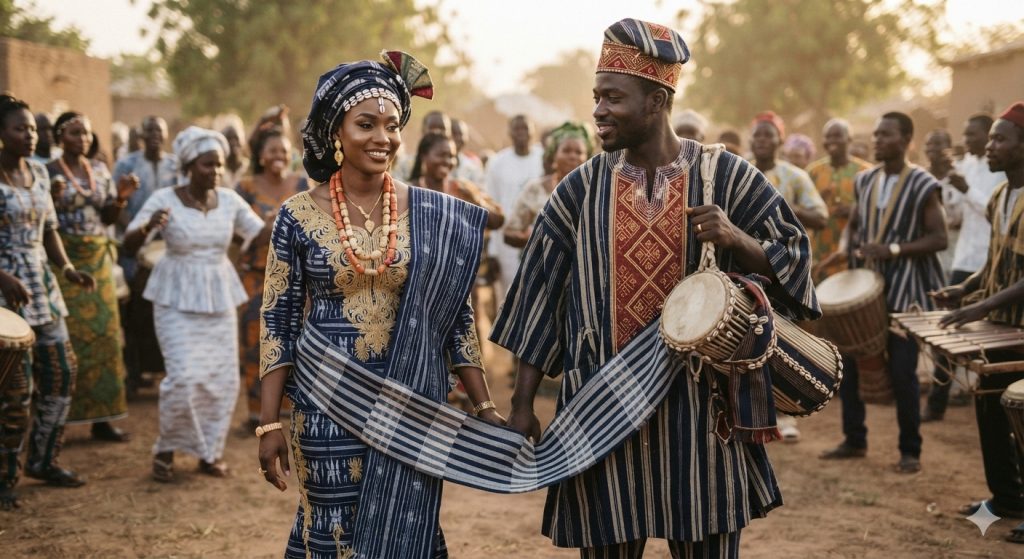
I always thought the vast distance between the Sahel and the green hills of northern Ghana meant we were worlds apart, until I stood at a traditional Gonja wedding and felt an overwhelming sense of déjà vu. Watching the bride step forward, her hair intricately braided with heavy beads and her body wrapped in the rich, earthy lines of handwoven strip-cloth, my mind flashed instantly to the Mandinka ceremonies of the far west. The majestic, flowing smocks worn by the Gonja men and the sacred veiling of the bride by the female elders weren’t just similar to Manding customs; they were a living mirror. In that single, breathtaking moment, the historical puzzle pieces clicked together, and I realized I wasn’t looking at a foreign ritual, but at the enduring heartbeat of a shared ancestry.
It is a beautiful yet heartbreaking truth that we are so profoundly alike, yet so starkly separated by the artificial lines of colonial borders. Centuries ago, Mandinka warriors and Wangara merchants marched south, blending their royal statecraft and textiles into the soil of Ghana to birth the Gonja Kingdom. They brought their souls with them, weaving their heritage into the very fabric of our marriages. Yet today, modern maps slice through the old West African empires, trapping us behind different national identities, language barriers, and bureaucratic checkpoints. Bureaucracy tells us we belong to different states, forcing us to speak French in one corner and English in another, while pretending that a line drawn on a European map can erase a bloodline.
But culture has a stubborn way of defying geography, and our weddings are the ultimate acts of rebellion against those colonial borders. Every time a Gonja bride adorns herself in gold or a groom steps out in a handwoven fugu, they are quietly honoring the Mandinka ancestors who laid down the foundations of their chieftaincy. We may carry different passports and live under different flags, but the rhythm of our drums and the patterns on our clothes speak a universal language that no border patrol can ever stop. We are a people divided by history’s ink, but forever bound together by the sacred threads of our traditions.
No Comments
Join the DiscussionBe the first to join the discussion!