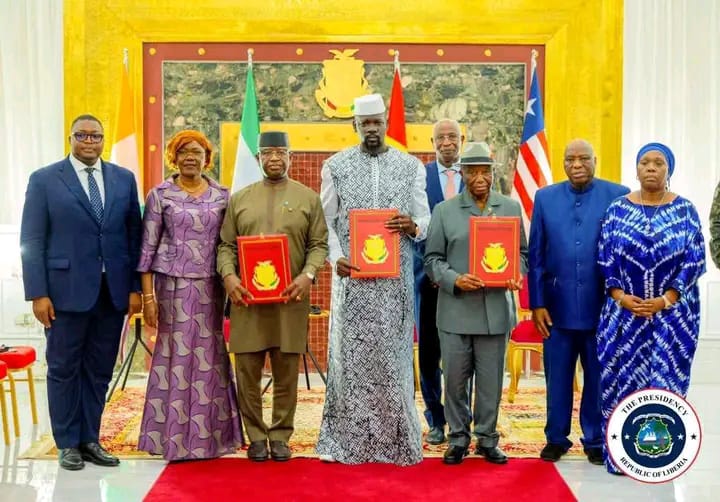
Three West African leaders have sent a clear and uncompromising message to the world: Africa will resolve its challenges through African solutions. In Conakry, Joseph Nyuma Boakai of Liberia, Mamadi Doumbouya of Guinea, and Julius Maada Bio of Sierra Leone rose above rising border tensions to embrace dialogue over division, reinforcing a shared continental vision rooted in peace, sovereignty, and brotherhood.
According to a press release from the Liberia Executive Mansion, the meeting was organized under the framework of the Mano River Union (MRU), the three West African leaders concluded what observers describe as a timely and strategic engagement aimed at defusing rising border tensions in the region. The summit, held in a frank yet cordial atmosphere, ended with a unified stance: Africa must resolve its own challenges through dialogue—not force.
At the heart of the discussions was a shared agreement to maintain the status quo ante along contested border areas while negotiations continue toward a lasting and mutually acceptable resolution. This decision reflects a deeper understanding of the historical, cultural, and economic interconnectedness of communities living along these borders—communities that have long thrived on cross-border trade and shared identity.
In a joint communiqué, the leaders emphasized that sovereignty, territorial integrity, and peaceful coexistence remain non-negotiable pillars of regional relations. They further committed to strengthening collective security efforts to confront emerging threats, including terrorism, transnational crime, and illicit trafficking—issues that continue to challenge stability across the continent.
Beyond security, the summit underscored a broader Pan-African vision—one that prioritizes economic cooperation, regional integration, and shared prosperity. The leaders pledged to promote joint development initiatives in border regions, focusing on trade, infrastructure, energy, and environmental sustainability, while also enhancing the free movement of people and goods.
Recognizing the urgency of recent border incidents, the three nations agreed to intensify collaboration among defense and security institutions through joint patrols, intelligence sharing, and improved communication between local authorities. They also directed relevant agencies to fast-track dialogue mechanisms, community engagement, and technical processes related to border clarification and demarcation, with support from regional and international partners.
Significantly, the leaders resolved to convene a broader MRU Summit within one month—an effort aimed at revitalizing the regional bloc and institutionalizing continuous dialogue on peace, security, and development.
This renewed commitment to cooperation signals more than just a diplomatic breakthrough—it represents a reaffirmation of Africa’s capacity to manage its own affairs through unity and mutual respect. In a world increasingly marked by conflict and division, the Conakry consultations offer a compelling example of African leadership rising to meet African challenges.
As Presidents Boakai and Bio return home, the message from Conakry is clear: the future of the region lies not in confrontation, but in collaboration. For the people of the Mano River basin, this moment could mark the beginning of a more stable, prosperous, and united West Africa.



No Comments
Join the DiscussionBe the first to join the discussion!