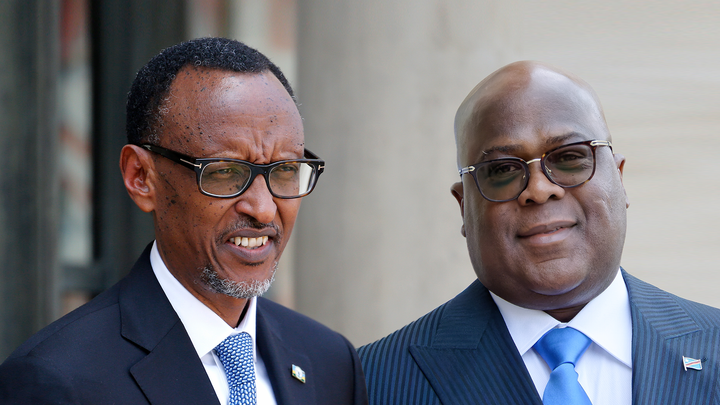
Rwandan President Paul Kagame has announced conditional measures to lift Rwanda’s “defensive measures” related to the conflict in eastern Democratic Republic of the Congo if Kinshasa fulfills its obligations under the Washington peace accord.
The president made the remarks on Friday while addressing diplomats accredited to Kigali at a dinner he hosted.
Kagame told diplomats that the Washington agreement laid out a ceasefire framework, acknowledged the security concerns of both countries and provided steps for implementing the deal. However, he argued that developments on the ground had raised concerns, citing what he described as a growing military buildup involving pro-government militias and the presence of Burundian troops operating in eastern Congo.
According to him, thousands of fighters linked to these forces had taken part in military activities in South Kivu while diplomatic discussions were still ongoing, a situation he said undermines the spirit of the agreement.
He stressed that all parties involved in the deal must be treated equally and should adhere to the commitments they signed.
Kagame maintained that Rwanda’s security concerns are largely linked to the continued presence of the FDLR militia in eastern Congo, describing the group as carrying an extremist ideology connected to the 1994 genocide in Rwanda.
“Rwanda, because of its history and its geography, requires defensive borders. Our defensive measures are aimed at this objective, and nothing else,” he said.
“Rwanda is ready to lift its defensive measures in tandem with the DRC fulfilling its obligations under the Washington Accords,” Kagame added.
His remarks came after the United States Department of State announced plans to impose visa restrictions on several senior Rwandan officials over allegations that they are contributing to instability in eastern Congo.
Rwanda and the DRC last December signed a peace and economic agreement in Washington spearheaded by the U.S. president, aimed at ending violence in Congo’s troubled eastern region.
Under the agreement, Rwanda signaled its willingness to withdraw forces it says were deployed for defensive purposes in eastern Congo. Both Kigali and Kinshasa also committed to halting any form of support to armed groups operating in the region, including the Democratic Forces for the Liberation of Rwanda (FDLR), a militia composed largely of Rwandan rebels based in eastern Congo.
In a statement on Friday, U.S. Secretary of State Marco Rubio said that by continuing to support the M23 rebel group and violating the Washington agreement, the targeted individuals were fueling violence and weakening stability across the Great Lakes region.
The announcement follows earlier sanctions imposed on the Rwanda Defence Force and four of its senior commanders over accusations that they provided operational assistance to the M23 movement.
Kagame said the crisis in eastern Congo has persisted for decades despite being widely understood, blaming the prolonged conflict on inaction and a lack of sustained efforts by those capable of helping resolve the situation.
Despite the U.S.-brokered agreement and a separate ceasefire initiative proposed by Angola last month, fighting has intensified in recent days, forcing thousands of civilians to flee their homes.The Congolese government, the United Nations and several Western countries have repeatedly accused Rwanda of backing the M23 rebel group, allegations Kigali continues to deny.



No Comments
Join the DiscussionBe the first to join the discussion!