

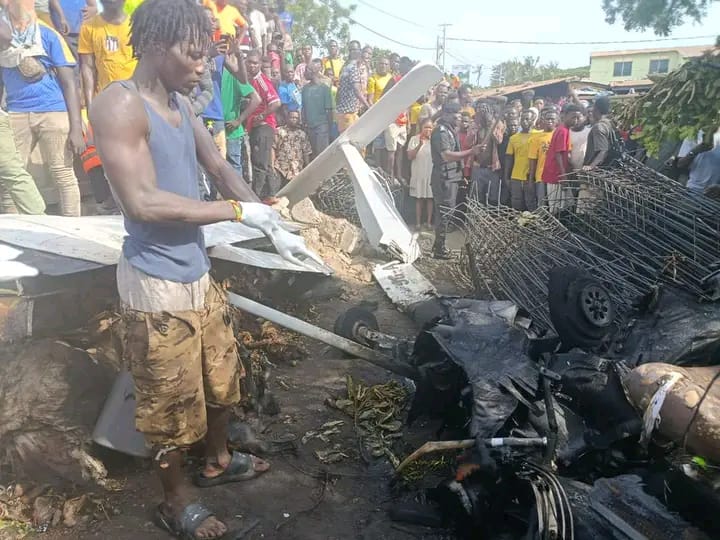
ACCRA, Ghana – A wave of grief and renewed concern has gripped Ghana following a series of aviation tragedies that have not only claimed lives but also exposed deep cracks in the country’s air safety systems.
The most devastating of these incidents occurred in August 2025, when a Ghana Air Force helicopter carrying top government officials crashed while en route from Accra to Obuasi. Among those killed were Defence Minister Edward Omane Boamah and Environment Minister Ibrahim Murtala Muhammed, along with six others.
The aircraft reportedly vanished from radar before its wreckage was later discovered in a forest, completely destroyed by fire. Government officials at the time described the incident as “a national tragedy of immense proportion,” while aviation analysts pointed to possible gaps in surveillance and aircraft monitoring systems.
A senior security source in Accra, speaking on condition of anonymity, said, “The loss was not just about leadership-it exposed serious operational concerns that must be addressed if we are to prevent future disasters.”
Barely months later, tragedy struck again.
In March 2026, a microlight aircraft crashed in Tema, a densely populated suburb of Accra, killing both occupants on board. Eyewitnesses reported that the aircraft burst into flames upon impact near a school park, narrowly avoiding what could have been a far more catastrophic incident involving civilians.
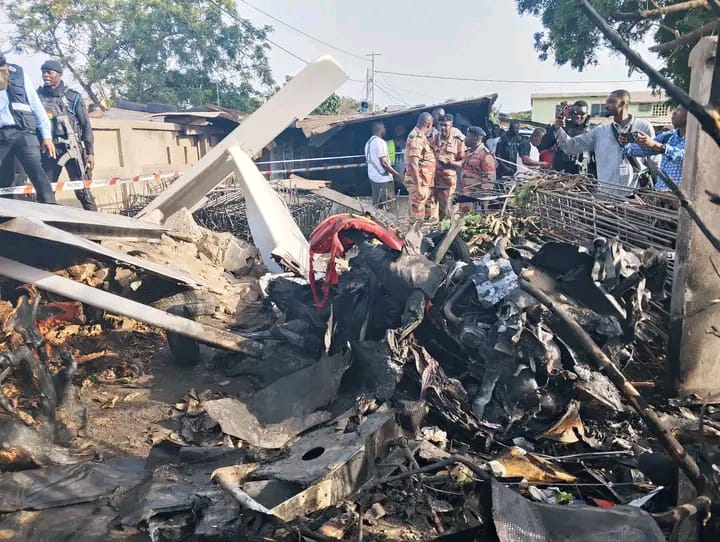
“It just dropped and exploded,” one resident told local media. “If it had landed a few meters away, we would be talking about many more deaths.”
Authorities confirmed the aircraft had lost communication shortly before the crash while en route from Ho to Accra—yet another troubling similarity with previous incidents.
A Pattern of Concern
While Ghana is not widely regarded as a high-risk aviation zone, a closer look at its history reveals a pattern that cannot be ignored.
In 2012, a cargo plane overshot the runway at Accra’s Kotoka International Airport and crashed into a bus, killing at least ten people. Two years later, in 2014, a helicopter operating offshore went down, resulting in multiple fatalities.
“These are not isolated events,” an aviation expert in West Africa noted. “They point to systemic issues—maintenance culture, regulatory enforcement, and investment gaps.”
A Continental Wake-Up Call
Across Africa, these tragedies echo a shared reality. From Ghana to Nigeria and beyond, the need for safer skies has become a continental urgency rather than a national concern.
An official within the African Union aviation framework recently emphasized that “Africa must move from reactive responses to proactive safety systems if it is to protect both leadership and citizens.”
Reimagining African Skies
Experts say the path forward lies in collective action. Through regional bodies like ECOWAS, countries can harmonize aviation standards, invest in modern tracking technologies, and strengthen oversight institutions.
“Safety cannot depend on geography,” a regional aviation consultant said. “Whether in Accra, Monrovia, or Abuja, the standard must be the same.”
From Mourning to Movement
For many observers, the repeated loss of lives must now translate into policy reform. Strengthening aviation authorities, investing in modern fleets, and building rapid-response systems are seen as critical steps.
As one Ghanaian policy analyst put it, “Every crash leaves behind lessons. The real tragedy is when those lessons are ignored.”
Africa Must Rise-Safely
Ghana’s pain is a reminder to the continent: progress without safety is fragile. As Africa continues its upward trajectory, its skies must reflect the same ambition-secure, reliable, and accountable.
Recommendations and Solutions
According to research, the repeated loss of lives in air disasters from Ghana to other corners of the continent-must awaken a deeper consciousness: that our skies, like our borders and our economies, are interconnected.
Aviation safety is no longer a domestic matter; it is a national responsibility that demands unity of purpose and collective action.
First, Africa must move toward a unified continental aviation safety standard under the leadership of the African Union.
No African country should operate below globally accepted safety thresholds.
A plane taking off in Accra, Monrovia, or Nairobi must meet the same uncompromising standard-because African lives carry equal value everywhere.
Second, there must be collective investment in modern aviation infrastructure. Through regional blocs such as Economic Community of West African States, nations can pool resources to deploy advanced radar systems, satellite tracking, and shared airspace monitoring.
Africa’s skies must no longer have blind spots where aircraft vanish without trace.
Third, the continent must prioritize African expertise and capacity building. Our pilots, engineers, and air traffic controllers must be trained to world-class levels within Africa, for Africa.
Institutions across the continent should collaborate to create centers of excellence that serve not just one nation, but the entire region.
Fourth, Africa must establish a continental rapid-response aviation unit—a coordinated emergency mechanism capable of immediate deployment when disasters occur.
Whether a crash happens in a forest in Ghana or offshore in another state, response time should not determine survival.
Fifth, there must be a culture of shared accountability and transparency. Findings from crash investigations should not remain within national borders but be shared across African states to prevent repetition of the same mistakes.
In unity, Africa can learn faster, respond better, and save more lives.
Ultimately, the vision is clear: an Africa where its skies reflect its aspirations-safe, connected, and sovereign.
The tragedies we witness today must become the foundation for a stronger tomorrow.
For Africa will rise—not in fragments, but together.
And when it rises, its skies must be as secure as its dreams.rely signing agreements—they are rekindling an ancestral bond, affirming that the destiny of African people, at home and abroad, is deeply intertwined. This is the spirit of togetherness in motion: a living testament that our shared history must give rise to shared progress, and that together, we can build a future anchored in dignity, opportunity, and collective empowerment for the global African family.



No Comments
Join the DiscussionBe the first to join the discussion!