

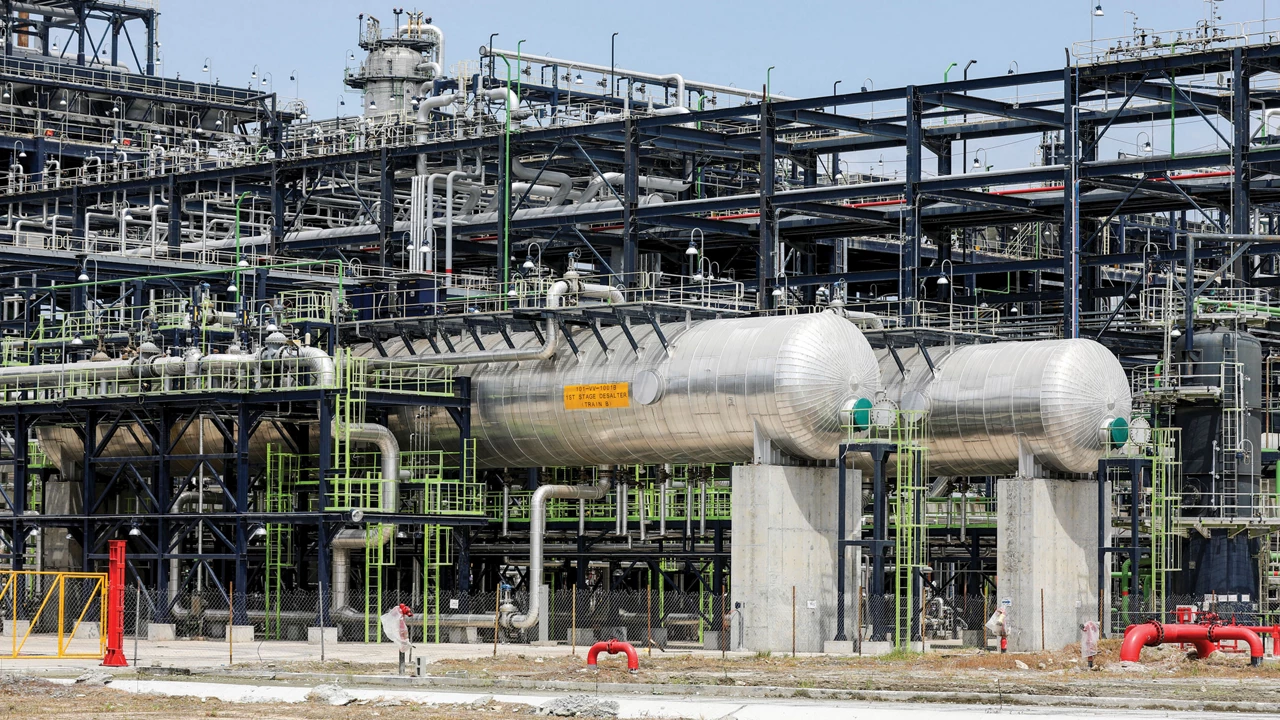
The queue of tanker trucks stretched for seven kilometers along the Lekki-Epe Expressway, a serpentine caravan of steel and rubber that snaked through the humid dawn. In the past, such a line would have spelled panic, a signal that fuel was about to vanish for weeks, that prices would double, and that the black-market barons would once again hold Nigeria hostage. But on this morning in late 2025, the drivers sipped tea and swapped stories. There was no fear. Because ahead of them, rising from the reclaimed swamp like a cathedral of modern industry, stood the Dangote Refinery.
For decades, the paradox of Africa has been brutal: a continent sitting on vast reservoirs of crude oil, yet perpetually kneeling at the pump. From Mombasa to Johannesburg, Dakar to Khartoum, African nations have sent billions of dollars abroad to import refined petroleum Europe, India, and the Middle East, growing rich on the continent’s own resources. But the war in the Middle East, which had escalated into a grinding, multi-front conflict, had severed traditional supply chains. Tankers from the Persian Gulf were being sunk or rerouted. Insurance premiums for Red Sea passages had become astronomical. And then came the fuel crises in Africa: Angola’s sole refinery broke down for the third time in a year; Ghana’s Tema Oil Refinery operated at 20% capacity; Sudan’s war-torn infrastructure collapsed entirely.
In this moment of continental desperation, a 650,000-barrel-per-day colossus in Lagos began to hum.
The Anatomy of a Lifeline
Aliko Dangote, the billionaire industrialist, stood on the catwalk overlooking the atmospheric distillation units. He was not a man given to public emotion, but as he watched the first shipment of Premium Motor Spirit (PMS) being piped into a tanker destined for Accra, his eyes glistened.
“For forty years,” he said, his voice low against the roar of the plant, “we were the richest poor people on earth. We pumped our oil to China and Europe, bought back their petrol at triple the price, and called it trade. No more.”
The Dangote Refinery, a $20 billion investment, was designed to be more than a Nigerian asset. It was a rebuke to the old colonial order where Africa’s role was merely extractive. With the capacity to process 650,000 barrels per day, it could satisfy 100% of Nigeria’s domestic demand for petrol, diesel, and jet fuel, and still have a surplus of over 300,000 barrels per day for export to neighboring countries.
And the timing could not have been more critical.
In Nairobi, Kenya, the price of a liter of petrol had soared to the equivalent of $2.50 USD. Bus drivers in Nairobi were staging go-slows. In Lusaka, Zambia, the national power utility had begun rolling blackouts because diesel for backup generators was being hoarded. The war in the Middle East had squeezed the Suez Canal route, and European refineries, reliant on Russian gas, had cut output. The global shipping crisis meant that a barrel of Brent crude delivered to Durban cost 40% more than it did just eighteen months prior.
But for African nations lucky enough to be within the Dangote supply web, the story was different. In January 2026, Dangote signed a landmark agreement with the African Export-Import Bank (Afreximbank) to create a Pan-African Petroleum Stabilization Fund. Under the deal, participating countries, Ghana, Senegal, Côte d’Ivoire, Niger, and Cameroon, would receive refined products at a fixed, below-market rate, payable in local currencies or through barter arrangements involving agricultural goods or minerals.
For the first time, an African refinery was not just selling fuel; it was engineering economic resilience.
The Geometry of Pan-African Supply
To understand why the Dangote refinery is a lifeline, one must first understand the absurdity of Africa’s pre-2024 fuel architecture. Africa produces roughly 7.5 million barrels of crude oil per day, about 8% of the world’s supply. Yet the continent possesses less than 1% of global refining capacity. Countries like Nigeria, Libya, and Angola export their light, sweet crude across the Atlantic or through the Straits of Malacca, only to import dirty, expensive refined products back from where the crude was sent.
Consider the arithmetic. In 2023, Nigeria exported roughly 1.4 million barrels per day of crude but imported over 500,000 barrels per day of refined products. The differential, the “crack spread” as traders call it, costs Nigeria an estimated $10 billion annually. That money did not build roads, fund schools, or pay doctors. It flowed to Rotterdam, Mumbai, and Houston.
Now multiply that across 54 nations. Africa’s total fuel import bill before the Dangote refinery came online was nearly $80 billion per year. Eighty billion dollars are leaving the continent every twelve months for a product that could be made at home.
The war in the Middle East laid this dysfunction bare. When Houthi missiles struck a Saudi Aramco facility in late 2025, global diesel prices spiked by 35% in a week. African nations, already struggling with debt and currency devaluation, faced a choice: starve their transport sectors or beg for IMF loans to buy fuel. Some, like Burkina Faso and Mali, chose the former. Trucks stopped moving. Food rotted at ports. Hospitals running on diesel generators went dark.
But in Lagos, Dangote’s crude distillation units were operating at 95% capacity, fed not by Middle Eastern oil but by Nigeria’s own Bonny Light and Forcados crude, supplemented by deliveries from Angola’s Cabinda province and Libya’s Sharara field. The refinery had been designed as a “hydro-skimming” plant with a residual fluid catalytic cracker, a technical way of saying it could handle the varied crude grades found across Africa, from the heavy, sour oil of Ghana’s Jubilee field to the light, sweet crude of Algeria’s Hassi Messaoud.
The Ripple Effect
By March 2026, the effects were measurable. Ghana, which had once relied on a dilapidated 45,000-barrel-per-day refinery at Tema, signed a five-year offtake agreement with Dangote. Within two months, fuel prices in Accra fell by 22%. The cedi stabilized. Fishermen in Tema, who had been unable to afford diesel for their outboard motors, returned to the sea.
Further west, Senegal’s President Bassirou Diomaye Faye struck a different kind of deal. In exchange for a guaranteed fuel supply from Dangote, Senegal agreed to export groundnuts, phosphates, and refined gold to Nigeria, a circular trade that kept value within the continent. “This is what Pan-Africanism looks like in the 21st century,” Faye declared at a joint press conference in Lagos. “Not flags and anthems, but pipelines and cargo manifests.”
Even landlocked nations felt the benefit. Niger, which had been paralyzed by a post-coup fuel blockade, now received diesel via a new pipeline from Lagos to the border town of Illela, and from there by truck to Niamey. The price of a bag of millet, which had quadrupled during the height of the crisis, fell by half.
The Grander Vision: A Continent of Refineries
Yet the Dangote Refinery alone cannot save Africa. As mighty as it is, the largest single-train refinery on earth, its 650,000 barrels per day represent only a fraction of the continent’s daily demand of nearly 4 million barrels. To truly break the cycle of fuel dependency, Africa needs not one giant, but a network of smaller, strategically located refineries.
This is where the Pan-African vision becomes an industrial roadmap.
Imagine a refinery in Cabinda, Angola, processing the country’s own deepwater crude for the Southern African Development Community (SADC). Imagine another in Djibouti, refining oil from South Sudan and Ethiopia’s nascent fields, supplying the Horn of Africa. Imagine a modular refinery in Liberia’s Buchanan, processing Nigerian crude for the Mano River Union.
The technology exists. Chinese and Indian firms have offered turnkey modular refineries, 10,000 to 30,000 barrels per day, that can be installed in eighteen months for a fraction of the cost of a mega-project. What has been missing is the political will and the financial mechanism.
But the war in the Middle East changed the calculus. The African Union, through its newly empowered Agency for Infrastructure and Energy, has drafted the “Lagos Declaration,” a binding commitment by thirty-two African nations to prioritize intra-African crude supply and local refining. Under the declaration, signatories agree to:
- Reserve 30% of their crude oil output for sale to African refineries at a discount of 10% below international spot prices.
- Waive import duties on refinery construction materials, catalysts, and spare parts.
- Create a Pan-African Petroleum Stabilization Fund capitalized at $15 billion by the African Development Bank and Afreximbank to underwrite new refinery projects.
“We are not asking for charity,” said Amani Abou-Zeid, the AU’s Commissioner for Infrastructure and Energy, in a speech to the Pan-African Parliament in Midrand. “We are asking for the right to refine what is ours. A barrel of crude refined in Lagos, Luanda, or Libreville is worth three times more than a barrel exported raw. That difference is the difference between poverty and prosperity.”
The Geopolitics of African Refining
Naturally, external powers are watching with unease. The European Union, whose refineries in Rotterdam and Antwerp have long processed African crude into diesel for African consumers, has filed a complaint with the World Trade Organization, alleging that the Lagos Declaration’s “reservation clause” violates global trade rules. Shell and TotalEnergies, which operate vast downstream networks in Africa, have lobbied Western governments to discourage refinery investments that would compete with their own import terminals.
But the war in the Middle East has drained Western moral authority. Why, African leaders ask, can Europe protect its agricultural sector with the Common Agricultural Policy, but Africa cannot protect its energy security? Why is it “free trade” when a Dutch refinery sells diesel to Dakar, but “protectionism” when a Nigerian refinery does the same?
“The West had its Industrial Revolution on the back of coal and colonies,” Dangote said in a fiery address to the United Nations General Assembly. “We are asking for a fair chance to have our own. We do not need your lectures. We need your capital, your technology, and then get out of our way.”
The Human Dimension
Beyond the geopolitics and the billions of dollars, the story of the Dangote refinery is ultimately a human one. In Cotonou, Benin, a motorcycle taxi driver named Ibrahim had watched his daily income halve during the height of the fuel crisis. Customers could not afford rides; petrol was too scarce. But when Dangote diesel began flowing across the border from Nigeria, the price at the pump dropped from 1,200 CFA francs per liter to 750 CFA. Ibrahim now works twelve-hour days, sends his children to a private school, and is saving to buy a second bike.
In Kano, northern Nigeria, a baker named Fatima had been forced to shut her three ovens because the cost of gasoil had bankrupted her. She now buys Dangote diesel at a stable price, bakes 500 loaves a day, and employs six women from her neighborhood.
And in the refinery itself, over 15,000 Nigerian workers, engineers, welders, lab technicians, logistics coordinators, earn wages that have revitalized the surrounding Lekki Free Zone. Housing estates have risen. Schools have opened. A Nigerian welder now earns the equivalent of his counterpart in South Korea.
The Road Ahead
The Dangote refinery is not a panacea. It faces challenges: pipeline vandalism, currency volatility, and the immense technical difficulty of running a world-class plant in a country with unreliable power and bureaucracy. Critics note that the refinery has yet to reach its full 650,000-barrel capacity due to feedstock constraints and startup teething problems.
But it has proven a concept that many had deemed impossible: that an African nation, with African capital and African labor, can build an industrial asset capable of competing with the best in the world. And in doing so, it has lit a fire.
Already, Uganda and Tanzania are fast-tracking the $4 billion East African Crude Oil Pipeline (EACOP) to feed a new 60,000-barrel-per-day refinery in Hoima, Uganda. Angola has revived plans for a 200,000-barrel-per-day refinery in Lobito. Algeria is expanding its Skikda refinery. And in South Africa, where Sasol and PetroSA have struggled, there is renewed talk of building a coastal refinery to process West African crude for the Southern African market.
The war in the Middle East taught Africa a painful lesson: global supply chains are fragile, and no one will save you. But out of that pain has come a fierce, pragmatic Pan-Africanism, one built not on rhetoric but on steel, catalysts, and the simple chemistry of turning crude into fuel.
As the sun set over the Lekki Peninsula, the tanker drivers finally reached the loading gantries. One by one, the trucks filled with diesel and petrol, their tanks gurgling with the promise of movement. Then they pulled away, heading north to Kano, west to Cotonou, east to N’Djamena, and south to Libreville. Behind them, the Dangote Refinery glowed against the twilight, a beacon not just of light, but of a continent finally learning to fuel itself.
The queue was gone. But the future had just begun.



No Comments
Join the DiscussionBe the first to join the discussion!