

Imagine a grand, ancient estate built around a single, sun-drenched courtyard. For centuries, two brothers lived there. They shared the same well, ate the fruit of the same olive trees, spoke the same dialect, and sang the same songs to their children. Their roots were so deeply intertwined beneath the soil that it was impossible to tell where the lineage of one brother ended and the other began.
Then came a bitter dispute over a strip of barren land at the back of the property.
Instead of sitting under the shade of the courtyard’s fig tree to talk, the brothers built a towering brick wall right down the middle of the estate. They sealed the doors, blocked the windows, and forbade their children from speaking across the divide. To justify the cost of the wall, each brother told his household that the other was an existential threat. Decades passed. The well dried up because neither could maintain it alone. The olive trees withered. The roof began to leak, threatening to collapse the entire estate on both families. Yet, the brothers kept buying expensive padlocks for their gates, staring into the mud, refusing to look up and see that they were destroying their shared inheritance.
This is the tragedy of modern North Africa. The estate is the Maghreb; the brothers are Morocco and Algeria.
The Reality of the Fracture: A Region of Fortresses
Today, the Maghreb is one of the least integrated regions on earth. When Morocco votes and alters its domestic landscape, it does so behind a fortress wall. Across the border, Algeria watches with deep suspicion, entrenched in its own defensive posture.
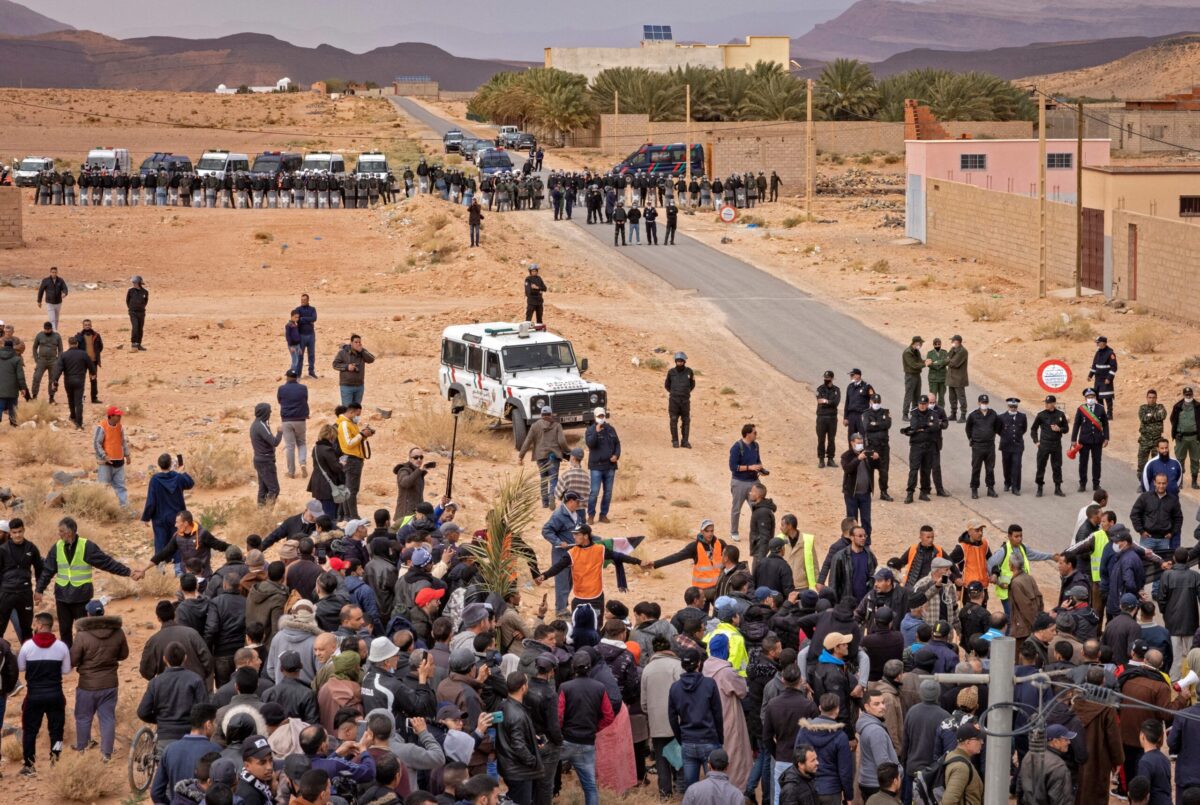
This is not merely a diplomatic disagreement; it is a total structural severing of two societies. The 1,600-kilometer land border between Morocco and Algeria has been completely closed since 1994, fortified with trenches, electronic surveillance, and military outposts. Since 2021, the airspace has been entirely sealed. A Moroccan citizen wishing to visit a dying relative in western Algeria—a distance that could be covered in a two-hour drive—must buy an expensive plane ticket, fly north to France or Spain, transfer, and fly back down to North Africa.
The economic cost of this wall is staggering. Economists estimate that the lack of regional integration costs both nations between 1% and 2% of their annual GDP growth. Together, they represent a market of nearly 100 million people, uniquely positioned between Europe, the Middle East, and Sub-Saharan Africa. Yet, because of the split, they do less than 5% of their total trade with each other.
Instead of building a hyper-connected economic superpower, both nations pour billions of dollars into a competitive arms race. As the Moroccan proverb wisely warns:
“He who buys what he does not need, sells what is precious to him.” (اللي يشري اللي ما عنده بيه غرض، يبيع الغالي عليه)
By spending billions on fighter jets and missile defense systems to protect against one another, both nations are selling what is truly precious: the future, education, and healthcare of their youth.
The Beautiful Tapestry: A History Written in the Same Ink
The tragedy of this conflict is magnified by the sheer beauty of the history they share. Long before modern colonial borders were drawn in the sand, Morocco and Algeria were part of a seamless civilization.
They share an indigenous Amazigh (Berber) foundation, overlaid by centuries of Islamic and Arab history. Their culinary traditions are identical—the steaming platters of Friday couscous, the aromatic tagines, the sweet mint tea poured from high above. Their music, from the classical Andalusian melodies of Fez and Tlemcen to the raw, poetic storytelling of Rai music, speaks the exact same emotional language.
More importantly, their modern freedom was forged in the same fire. When Algeria launched its brutal, heroic War of Independence against French colonial rule in 1954, Morocco did not stand idly by. The Moroccan border towns of Oujda and Berkane became safe havens, logistics hubs, and military bases for the Algerian National Liberation Front (FLN). The Moroccan people shared their food, their homes, and their weapons with their Algerian brothers. Future Algerian leaders lived and operated out of Morocco during the war.
The two nations understood then that their destinies were bound together. They embodied the ancient Algerian proverb:
“A neighbor close by is better than a brother far away.” (جارك القريب خير من خوك البعيد)
They knew that when the colonial house was burning, they were each other’s only true bucket of water.
The Root of the Poison: What Caused the Split?
How did brothers-in-arms become bitter rivals? The unraveling began almost immediately after Algeria gained independence in 1962.
The French empire had drawn arbitrary borders that left the desert boundaries undefined. In 1963, a brief border skirmish known as the “Sand War” broke out between the two newly formed states. Though short-lived, it left a deep wound of psychological mistrust. Morocco feared a revolutionary, Soviet-backed socialist republic on its eastern border; Algeria feared a Western-backed expansionist monarchy to its west.
The definitive rupture, however, occurred in 1975 over the territory of Western Sahara.
When Spain withdrew from the colony, Morocco claimed the territory based on historical ties to the Moroccan throne. However, a local independence movement, the Polisario Front, demanded an independent state for the Sahrawi people. Algeria, seeking to check Morocco’s geopolitical ambitions and secure its own strategic access to the Atlantic Ocean, became the primary financial, military, and diplomatic patron of the Polisario Front.
For fifty years, this issue has acted as a geopolitical chokehold. To this day, Morocco views its sovereignty over Western Sahara as a non-negotiable red line of national integrity. Algeria views its support for the Polisario as a principled defense of anti-colonial self-determination and a necessary check against Moroccan dominance. It has become a zero-sum game: any diplomatic victory for Rabat is viewed as an existential defeat in Algiers.
Echoes Across the Continent: The Twin Tragedy of Ethiopia and Eritrea
This painful parable of two brothers locked behind self-destructive walls is not unique to North Africa; a striking mirror image of this exact tragedy has played out for decades in East Africa between Ethiopia and Eritrea. Like Morocco and Algeria, Ethiopians and Eritreans share deep ancestral bloodlines, intertwined highlands, ancient languages, and centuries of overlapping history. Even more remarkably, their modern political leaderships were forged as brothers-in-arms, fighting side by side in the late twentieth century to overthrow a brutal military dictatorship in Addis Ababa. Yet, almost immediately after Eritrea gained formal independence in 1993, arbitrary colonial-era border lines and disputes over trade and currency poisoned their brotherhood, culminating in a devastating border war from 1998 to 2000 over the barren frontier town of Badme.
For nearly twenty years following that war, East Africa witnessed the same unnatural severing that paralyzes the Maghreb today. Land borders were heavily mined and fortified, direct flights and telephone lines were cut, and families living just miles apart were forced to travel across continents simply to embrace one another. Landlocked Ethiopia lost its natural, historic access to Eritrea’s Red Sea ports of Assab and Massawa—forcing Addis Ababa to pay billions in transit fees elsewhere—while Eritrea’s coastal cities withered without the vibrant trade of Ethiopia’s massive consumer market. Both nations poured their scarce national wealth into massive standing armies and proxy conflicts across the Horn of Africa, sacrificing the economic potential of over 120 million people at the altar of mutual suspicion.
While a historic 2018 peace accord briefly cracked open the border—allowing tearful family reunions and booming cross-border markets to flourish overnight—the absence of deep institutional guardrails and lasting economic integration meant that old geopolitical rivalries soon crept back in, chilling relations once more. The Horn of Africa’s struggle proves a vital lesson for the Maghreb: a handshake between leaders is fragile unless it is anchored by permanent regional frameworks, shared infrastructure, and grassroots youth exchange. Whether in East Africa or North Africa, the lesson remains identical—when neighboring brothers weaponize their borders, both nations starve in the shadow of their own walls.
The External Catalyst: The Framework for Global and Institutional Mediation
To heal a wound this deep, direct dialogue between Rabat and Algiers is not enough; peace must be cultivated through external, neutral third parties. By constructing a dual-mediator framework combining the African Union (AU) and the Kingdom of Saudi Arabia, the international community can deploy a unique blend of continental solidarity and economic diplomacy.
Saudi Arabia as the Economic Diplomat
Saudi Arabia enjoys an intimate, decades-long fraternal relationship with the Moroccan monarchy, while maintaining vital energy and security partnerships with the Algerian government. Saudi Arabia can act as the financial guarantor of a peace deal, proposing a multi-billion-dollar Maghreb Integration and Infrastructure Fund. This fund would be unlocked only upon the signing of a comprehensive border-opening agreement. By hosting proximity talks in Riyadh away from the glare of international media, Saudi Arabia can offer both leaderships a prestigious, face-saving platform to negotiate, echoing the Moroccan proverb: “The modern stranger can leave, but your traditional brother remains.”
The African Union as the Institutional Architect
The African Union (AU) provides the structural framework for long-term integration under its mandate of “African solutions to African problems.” The AU can force both nations to the table by demonstrating that their stubborn rivalry creates a dangerous power vacuum to their south in the volatile Sahel region, where extremist groups thrive. The AU can present a joint security framework where Morocco and Algeria co-chair an intelligence-sharing and border-patrol command. This mirrors the classic Algerian proverb:
“Two heavy stones can grind grain, but one alone does nothing.”
The AU can show that unless the two giants of North Africa grind together, the security and economic goals of the entire continent—including the African Continental Free Trade Area (AfCFTA)—will crumble.
The Ultimate Reward: Unleashing the Youth and Border Cities
The strongest argument for this mediated peace is the sheer human and economic dividend it will pay to the most vulnerable population in both nations: their youth.
The Youth Employment Shockwave
Both nations are currently sitting on a demographic time bomb. In Morocco, youth unemployment sits stubbornly high at 27.2%, while in Algeria, more than one in four young people under the age of 30 are unemployed. Millions of university graduates are trapped in the precarious informal economy or risk their lives on migration routes to Europe.
Opening the borders would act as a massive economic shockwave, instantly creating an integrated market of 100 million consumers. Instead of local startups and small businesses being confined by artificial boundaries, a young entrepreneur in Algiers could seamlessly scale their digital platform into Casablanca, while a Moroccan agricultural or logistics firm could hire engineering talent in Oran. By eliminating trade tariffs, the region would naturally absorb the 180,000 university graduates Morocco produces annually and the thousands of skilled young professionals Algeria’s education system generates. Regional integration would create an estimated 200,000 to 300,000 sustainable formal jobs for youth within the first three years alone, transforming their young workforces from a socio-political liability into an absolute competitive advantage against an aging Europe.
The Transformation of the Frontier Cities
When the walls crumble, the greatest physical and economic transformations will occur in the historic borderlands. For decades, cities located near the frontier have wrestled with the peculiar challenges of isolation, turning heavily to informal cross-border smuggling networks to survive. Under a unified Maghreb, these peripheral zones will transform overnight into roaring cosmopolitan trade hubs.
- Oujda (Morocco): Located a mere 13 kilometers from the Algerian border, Oujda has historically been isolated from Morocco’s western economic cores. An open border transforms Oujda from a dead-end frontier into the premier land gateway of North Africa. Oujda’s existing Technopole (high-technology industrial cluster) would expand rapidly, serving as a regional manufacturing and offshoring hub for both Moroccan and Algerian enterprises. Its nearby Mediterranean resort city of Saidia would see an explosion in regional tourism, welcoming millions of Algerian vacationers who could simply drive across the border.
- Tlemcen and Maghnia (Algeria): Directly across the border, the historical Algerian cultural capital of Tlemcen and its twin trade outpost, Maghnia, would undergo an identical renaissance. Tlemcen’s rich architectural, academic, and agricultural resources would become immediately accessible to Moroccan markets. Joint industrial zones could be built between Oujda and Tlemcen, allowing Moroccan manufacturing expertise (such as automotive parts and textiles) to merge with Algeria’s low-cost energy inputs.
- The Global Metropolises: This transformation extends far beyond the borderlands. Morocco’s globalized industrial cities like Tangier and Casablanca—which house Africa’s largest deep-water port, Tanger Med—would become the primary maritime gateways for Algerian non-hydrocarbon exports. Conversely, Algerian industrial powerhouses like Algiers and Oran would finally have a direct, unhindered land route to distribute petrochemicals, plastics, and fertilizers westward into Morocco and down into West Africa.
As the Moroccan proverb notes:
“A single hand cannot clap.” (يد واحدة ما تصفقش)
Algeria cannot achieve true economic diversification alone; Morocco cannot sustain its export-driven miracle without regional depth. Together, however, they hold the keys to the entire Mediterranean basin.
Accelerating the Continent: Unlocking the AfCFTA Across West and North Africa
The reconciliation of Morocco and Algeria does not merely heal a local wound; it unlocks the ultimate crown jewel of continental economics: the African Continental Free Trade Area (AfCFTA).
Currently, Africa is severely restricted by internal trade fragmentation. The AfCFTA aims to create the world’s largest free trade area by connecting 1.3 billion people across 54 countries. However, the Morocco-Algeria split acts as a massive geographical block at the very top of the continent. It breaks the natural North-South and East-West logistical pipelines.
When the borders open, a historic trade synergy will be unleashed across North and West Africa:
- The Logistical Breakthrough: Unblocking the terrestrial routes means freight trucks can travel unimpeded from Cairo and Tunis, through Algiers and Casablanca, and directly down the Atlantic coast into Dakar, Abidjan, and Lagos. Logistics costs across West and North Africa would plummet by an estimated 25% almost overnight.
- The Industrial Supply Chain Matrix: Morocco’s booming automotive and aerospace ecosystems can seamlessly source chemical raw materials and polymers from Algeria’s massive industrial complexes. These finished products can then be exported tariff-free to West Africa’s expanding middle-class markets. In return, West African agricultural and mineral goods gain cheap, direct land access to Mediterranean maritime trade routes.
- The Fertilizer and Food Security Alliance: Morocco holds over 70% of the world’s phosphate reserves, a critical ingredient for fertilizer. Algeria produces massive quantities of ammonia and urea from its natural gas. Weaving these two assets together under the AfCFTA framework allows for the mass production of hyper-affordable, tailored fertilizers. This alliance can single-handedly power an agricultural revolution across Sub-Saharan Africa, securing food independence for the entire continent.
Grassroots Reconciliation: The AU Maghreb Youth Exchange Blueprint
While economic treaties are signed by politicians, lasting peace must be woven into the minds of the next generation. To prevent future political regression, the African Union can institutionalize a grassroots reconciliation initiative: The AU Maghreb Youth Exchange Program.
This structured framework is designed to actively dismantle decades of media-driven stereotypes and state-sanctioned mistrust through direct human connection:
| Core Component | Mechanism | Objective |
|---|---|---|
| The Ibn Battuta Academic Fellowship | The AU funds annual cohorts of 5,000 Moroccan and Algerian university students to spend a semester studying at universities across the border (e.g., Algiers students in Fez; Casablanca students in Oran). | To foster lifelong academic collaborations and personal friendships among future leaders. |
| The Borderland Innovate Hackathons | A revolving, biannual technology and entrepreneurship incubator held alternately in Oujda and Tlemcen. | Bringing young tech minds together to solve shared regional crises like water scarcity and renewable energy integration. |
| The Rai-Mouro Cultural Festival | An annual traveling music and arts caravan celebrating their identical Andalusian and Amazigh cultural legacies. | Utilizing the shared emotional power of music to publicly bridge the social divide. |
By funding these cross-border spaces, the African Union ensures that young Moroccans and Algerians see themselves not as existential enemies, but as partners in a common destiny. They realize they are two sides of the exact same coin.
Conclusion: A Call to the Courtyard—And a Blueprint for a Unified Continent
The current state of cold war between Morocco and Algeria—much like the parallel estrangement dividing Ethiopia and Eritrea in the Horn of Africa—is an unnatural deviation from the grand arc of African history. Across the continent, from the Red Sea coast to the Atlantic shores of the Maghreb, inherited colonial lines and zero-sum rivalries have turned natural brothers into fortified neighbors. These self-inflicted wounds do not merely trap individual nations in costly arms races; they hold back the entire African continent, which depends on regional powerhouses like the Maghreb to serve as engines of growth and anchors of stability.
Yet, the blueprint to dismantle these walls is already within reach. As the lessons of East and North Africa make clear, lasting peace cannot rest on fragile handshakes alone; it must be engineered through deliberate, multi-layered remedies. It requires trusted external catalysts—such as Saudi Arabia’s economic diplomacy paired with the African Union’s institutional architecture—to provide dignified, face-saving pathways to compromise. It demands transforming isolated frontier zones like Oujda and Tlemcen into thriving joint industrial hubs, weaving complementary resources into continental supply chains under the AfCFTA, and anchoring diplomacy in grassroots initiatives like the AU Maghreb Youth Exchange Program so that future generations never again mistake their neighbors for enemies.
At the heart of this continental awakening stands the grand courtyard of North Africa. The brick wall splitting Morocco and Algeria must be the first and most decisive barrier to fall. Guided by regional solidarity and institutional courage, the leaders in Rabat and Algiers must step out into the sunlight, sit beneath the olive trees of their shared heritage, and recognize that their true security lies in their brotherhood. To inspire this historic shift from hostility to harmony, the leaders and peoples of both nations—and their brothers and sisters across Africa—must cling to the profound proverb that echoes across the mountains and deserts of the Maghreb:
“Be close like the fingers of a hand, and no stone can break you.” (كونوا كي صباع اليد، حتى حجر ما يهرسكم)
By weaving their destinies back together, Morocco and Algeria will do far more than heal their own divided estate; they will ignite a continental chain reaction of reconciliation, proving that when Africa’s brothers tear down their walls, no stone can ever break their collective rise into a new dawn of peace, dignity, and shared prosperity.



No Comments
Join the DiscussionBe the first to join the discussion!