

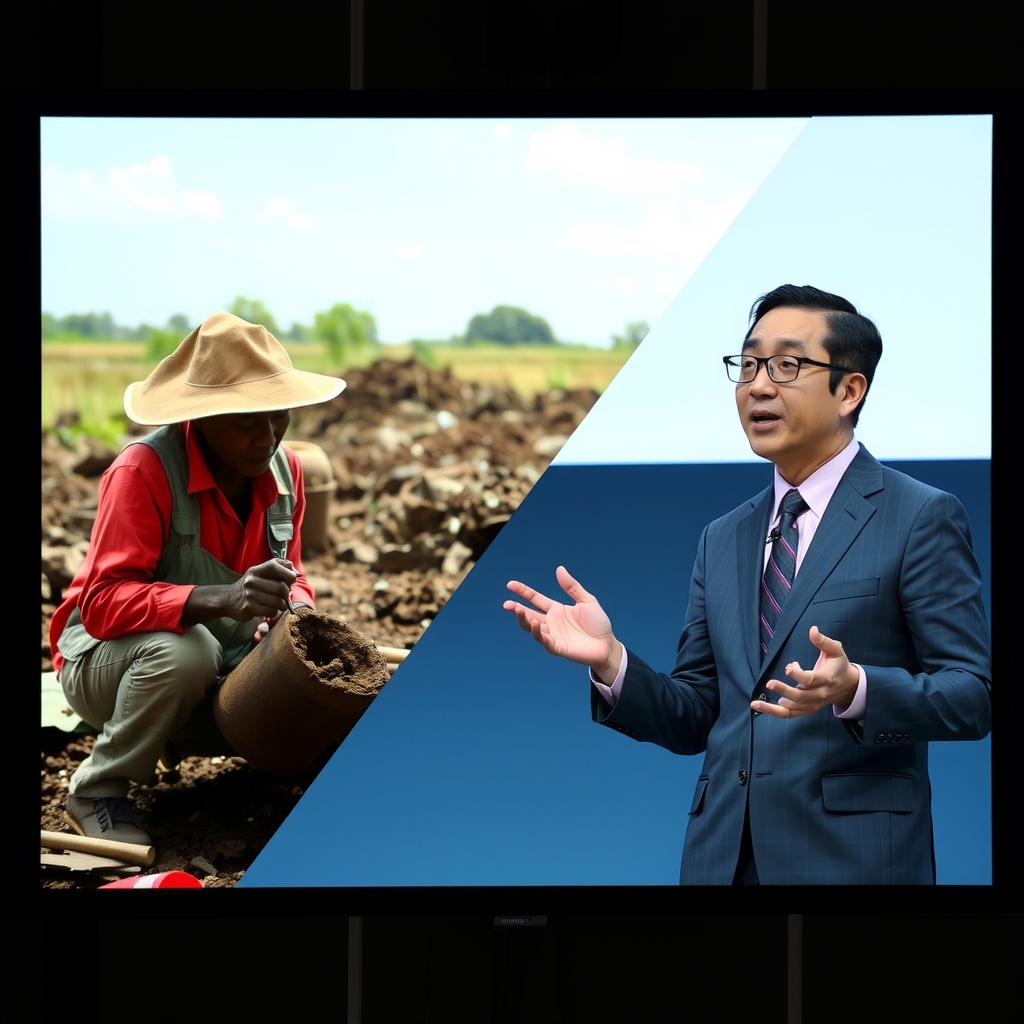
At the Debswana Diamond Company sorting facility in Gaborone, workers under bright lights classify stones by size, clarity, and color—the final stage of a supply chain that has anchored Botswana's economy for five decades. Diamonds still account for roughly half of government revenue and dominate export figures. But with an estimated 35 years of commercial reserves remaining and global demand softening, the country faces a question that is as much about choice as constraint: what comes next?
Botswana has one of the strongest long-run growth records on the continent. According to World Bank data, GDP per capita in purchasing power parity terms stood at approximately $16,800 in recent years (Source: World Bank World Development Indicators). Real GDP per capita in constant 2015 dollars has grown steadily since independence in 1966, rising from less than $1,000 to over $6,000 by the early 2020s, reflecting prudent fiscal management, stable institutions, and disciplined use of mineral wealth (Source: World Bank World Development Indicators). The country is recognized for its good governance, political stability, independent judiciary, and accountable institutions (Source: African Development Bank, "Making Botswana's Capital Work Better for its Development").
That income level, and the institutional foundation beneath it, invites a different kind of comparison—not to illustrate a gap, but to map a possible trajectory. When did another economy stand where Botswana stands now, and what did it do in the following decades?
South Korea reached a similar level of GDP per capita—between $6,000 and $7,000 in constant dollars—in the late 1980s to early 1990s, depending on the measurement base used (Source: FRED, St. Louis Fed; World Bank World Development Indicators). [Exact matching year depends on whether constant 2015 dollars or PPP terms are used; sources provide series but not a single definitive crossover year. The range is approximately 1987–1992 based on available constant-dollar series.] What Korea did in the two decades that followed offers a road map, not a prescription.
From that point forward, Korea diversified its industrial base, moving from labor-intensive manufacturing into heavy industry, chemicals, shipbuilding, and eventually semiconductors and information technology. The government and large conglomerates—the chaebol—systematically identified gaps in domestic value chains and invested in technology acquisition, human resource development, and construction of globally competitive production facilities (Source: "The Chaebol and Industrial Policy in Korea"). Export markets diversified beyond the United States to include Europe and Asia. By the mid-1990s, Korea was recording average annual growth of 8.8 percent, driven by heavy industries oriented toward export markets (Source: "Some Lessons from Korea's Industrialization Strategy"). Even as domestic demand grew, Korea's strategic focus remained on global competitiveness and continuous movement up the quality ladder.
Korea also invested heavily in education and skills development, even when the country was relatively poor (Source: "Chaebol and Industrial Policy in Korea"). Technical capacity was built through apprenticeships, public-private partnerships, and alignment of tertiary and vocational training with industrial needs—precisely the areas where Botswana now seeks to improve (Source: African Development Bank, "Making Botswana's Capital Work Better for its Development").
What differs between Botswana's position today and Korea's in the late 1980s is not institutional quality—Botswana scores well on governance and macroeconomic management—but market size and economic structure. Botswana's population is approximately 2.6 million, compared to South Korea's 50 million-plus. The domestic market is small, and the economy remains heavily dependent on a single commodity. Diamonds accounted for 88 percent of export value as recently as 2016 (Source: "Botswana Struggles to Diversify Exports beyond Diamonds"). The diamond industry contributes little to employment, and its linkages to the broader economy are weak. According to the World Bank, Botswana ranks 115th out of 133 countries on the Harvard Economic Complexity Index, reflecting low product diversification and limited sophistication in non-mining exports (Source: World Bank, "At a Crossroads: Reigniting Efficient and Inclusive Growth").
The economy is diversifying slowly—services have grown as a share of GDP, and manufacturing accounts for roughly 5 percent of output, including food processing, textiles, and beverage production (Source: Economy of Botswana, Wikipedia; World Bank, "At a Crossroads"). But external demand for Botswana's non-diamond goods remains limited, and labor productivity outside mining is low (Source: World Bank, "At a Crossroads").
This is where regional and continental market access becomes strategically decisive. Botswana is a member of the Southern African Customs Union (SACU), along with Eswatini, Lesotho, Namibia, and South Africa. SACU is the only regional bloc in Southern Africa with a common trade acquis and a unified external tariff, and it is the only bloc in the region that has submitted a common market access offer under the African Continental Free Trade Area (AfCFTA) (Source: "Accelerating the implementation of the AfCFTA in Southern Africa"). The AfCFTA, now operational, opens access to a market of 55 countries, 1.4 billion consumers, and more than $3.4 trillion in combined GDP (Source: "Regional economic integration takes centre stage at SACU Summit").
At the Ninth SACU Summit in Midrand in 2024, leaders emphasized that industrialization tied to the AfCFTA can deliver more than higher trade volumes—it can support the construction of regional value chains, reduce dependence on volatile global commodity markets, and enable member states to capture economies of scale that small domestic markets cannot provide on their own (Source: "Regional economic integration takes centre stage at SACU Summit"). For Botswana, full use of SACU and AfCFTA frameworks could allow diversification into manufacturing and services with market access comparable, in aggregate population and GDP, to what Korea enjoyed through its own regional trade networks and global export push.
The choices ahead are institutional and strategic. Botswana's government has already launched export diversification strategies aligned with its long-term development plan and Vision 2036, which aims for high-income status (Source: "Botswana Struggles to Diversify Exports beyond Diamonds"). The creation of a multi-billion-pula Diamonds for Development Fund, announced as part of a recent agreement with De Beers, is intended to channel diamond revenue into economic diversification (Source: "State of the Diamond Industry: Botswana Beyond Diamonds"). But policy frameworks must be matched by execution: aligning skills training with market demand, supporting entrepreneurship, reducing regulatory barriers for the private sector, and building capacity in export-oriented manufacturing and services (Source: African Development Bank, "Making Botswana's Capital Work Better for its Development").
SACU and the broader Southern African Development Community (SADC) also have roles to play. Accelerating implementation of the AfCFTA, harmonizing standards, and deepening intra-regional trade in intermediate goods can lower the cost of industrialization for all member states and make regional markets a viable platform for scale (Source: "Accelerating the implementation of the AfCFTA in Southern Africa").
Korea's trajectory was not inevitable. It was the product of decades of deliberate investment in skills, technology, and export capacity, underpinned by institutional discipline and access to large external markets. Botswana has the institutional foundation and the fiscal resources. What it does not have is time to wait. The diamond reserves are finite, global demand is under pressure from synthetic alternatives, and the window for deploying resource rents into structural transformation is narrowing (Source: "State of the Diamond Industry: Botswana Beyond Diamonds"; Economy of Botswana, Wikipedia).
The next 20 years will show whether Botswana, anchored in a more integrated Southern African market, can follow the trajectory Korea began in the late 1980s—or whether the advantage of strong institutions and accumulated savings will be left unrealized. The sorting floor in Gaborone is still lit. The question is what else will be built around it.



1 Comment
Join the Discussion[…] Botswana and South Korea: Two Economies at the Same Turning Point […]