DAKAR – For more than a century, the Olympic movement has travelled across continents, bringing together the world’s athletes under one flag of competition, friendship and human possibility.
But there has always been one glaring absence. (Africa).
That historic omission will finally end in October 2026 when Dakar, Senegal, welcomes the world for the Dakar 2026 Youth Olympic Games, the first Olympic sporting event ever to be held on African soil.
From October 31 to November 13, 2026, Senegal will not merely host a sporting competition. It will open a new chapter in the history of the Olympic movement and, potentially, in Africa’s relationship with international sport.
This is bigger than Senegal. This is bigger than West Africa. This is an African moment.
A historic door finally opens
Africa has produced some of the world’s greatest athletes.
From Ethiopian and Kenyan distance runners to South African swimmers, Nigerian sprinters, Moroccan footballers and countless champions across the continent’s sporting landscape, African athletes have repeatedly demonstrated that talent has never been the continent’s problem.
Opportunity has been.
For generations, African athletes have travelled abroad to compete on stages designed and hosted elsewhere. Africa has supplied champions, spectators, journalists, coaches and sporting personalities to the global Olympic movement, yet the continent had never hosted an Olympic sporting event. Dakar changes that.
The International Olympic Committee describes Dakar 2026 as the first Olympic sporting event to be staged in Africa. The significance of that distinction cannot be overstated.
When the Olympic flame arrives in Senegal, it will represent more than the beginning of another sporting tournament.
It will represent the arrival of Africa at a stage from which it has been historically absent.
Dakar is carrying the continent’s flag
Senegal’s selection is significant not only because it becomes the first African host, but because the country is using the Games to present its own culture, identity and youth to the world.
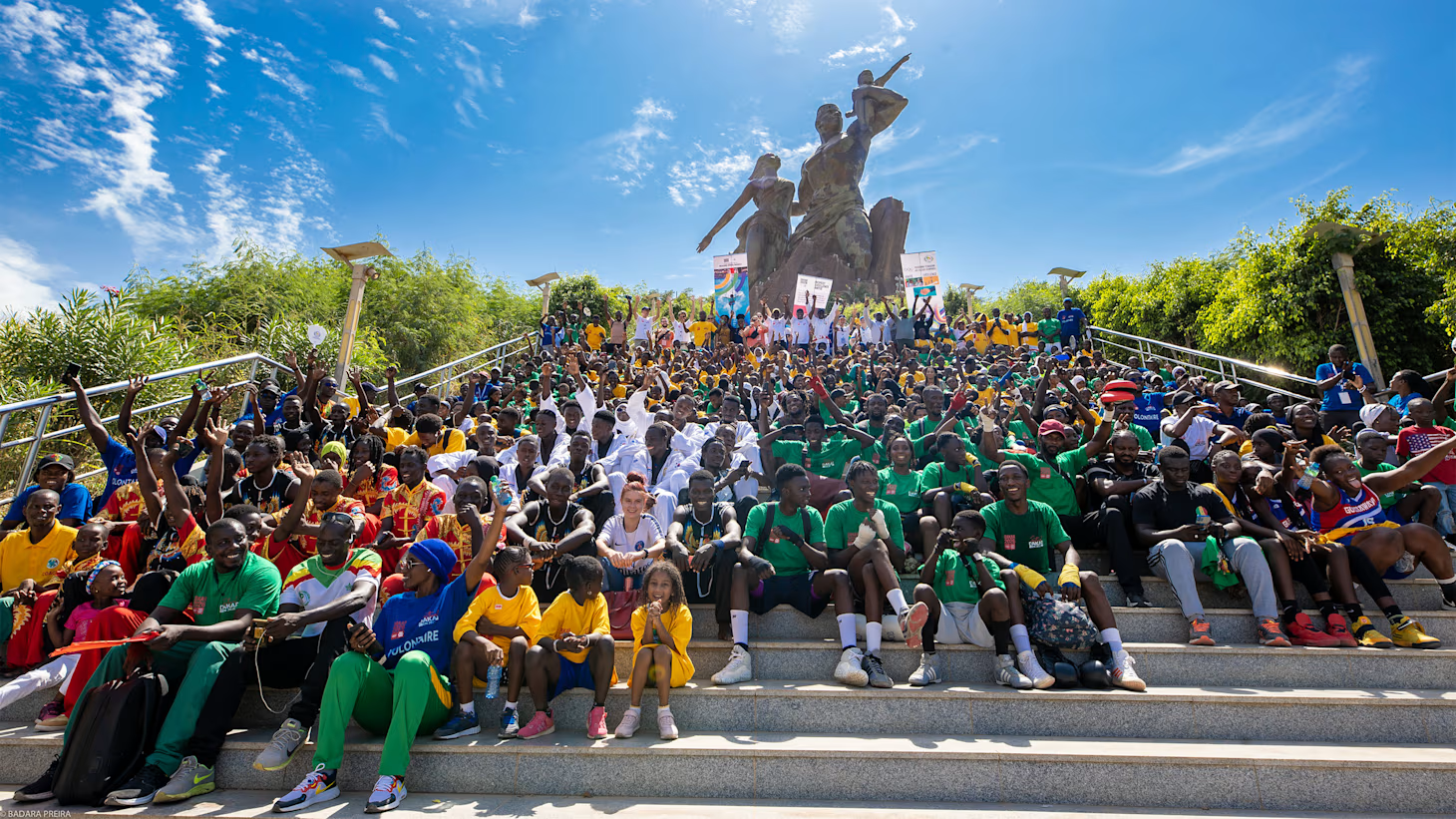
The competition will take place across Dakar, Diamniadio and Saly, bringing together sport, culture and youth engagement. The program is expected to feature 25 competition sports, 10 engagement sports and 153 medal events, with approximately 2,700 athletes aged up to 17 participating.
That means Dakar 2026 is not simply about finding the next generation of Olympic champions.
It is also about introducing the next generation of Africans to the possibilities of sport.
The Youth Olympic Games have historically provided a pathway for young athletes who later become senior Olympic stars. Athletes such as South Africa’s Chad le Clos, Great Britain’s Tom Daley, Brazil’s Thiago Braz, Australia’s Jessica Fox, Saint Lucia’s Julien Alfred and American Noah Lyles all have Youth Olympic backgrounds.
Imagine what it could mean for an African teenager watching Dakar 2026 from Monrovia, Accra, Nairobi, Lagos, Kigali, Cairo or Johannesburg.
For that young person, the message is simple:
You can compete here.
You can win here.
Africa can host here.
Africa belongs here.
The Olympic flame is coming home to Africa
The symbolism became even more powerful in September.
On September 10, the Youth Olympic flame was lit at the historic Panathenaic Stadium in Athens, Greece, before beginning its journey to Senegal. It arrived in Dakar on September 12, marking the next stage of the countdown to the historic Games.
There is something deeply symbolic about that journey.
The Olympic tradition began in ancient Greece.
The modern Olympic movement was revived in Europe.
And now, more than a century later, the Olympic flame is travelling to Africa for an Olympic sporting event for the first time.
The symbolism should not be lost on the continent.
Africa is not receiving charity.
Africa is not being invited merely to participate.
Africa is hosting.
A sporting event – but also a development opportunity
The most important question after the closing ceremony will not simply be: Who won the medals?
It should be:
What remains after the athletes leave?
The true measure of Dakar 2026 will be its legacy.
The Games provide Senegal with an opportunity to strengthen sporting infrastructure, develop young professionals, improve event-management expertise, expand tourism and demonstrate that African cities can successfully deliver major international sporting events.
The IOC has already highlighted the delivery phase involving Dakar, Diamniadio and Saly, with organizers and local authorities working together on venues and preparations.
There is also a human legacy.
The Dakar 2026 Learning Academy, for example, is designed to provide opportunities for young professionals to gain experience connected to the Games. The story of Senegalese worker Sokhna Dia, who moved from working as a cleaner at the organizing committee to becoming part of its learning program, illustrates how major sporting events can create opportunities beyond the playing field.
That is the kind of legacy Africa needs.
Dakar 2026 and the Pan-African opportunity
For the rest of Africa, Dakar 2026 should also be viewed through a wider lens.
The continent has often spoken about Pan-Africanism through politics, history and culture.
Sport provides another powerful form of Pan-African connection.
A Liberian child can identify with a Senegalese athlete.
A Kenyan runner can inspire a young Ghanaian.
A Nigerian boxer can motivate a Gambian teenager.
A South African swimmer can become a role model for a young athlete in Sierra Leone.
This is the soft power of sport.
And Dakar provides Africa with a rare opportunity to tell its own story through one of the world’s most recognizable sporting movements.
Rather than allowing the world to define Africa exclusively through poverty, conflict or crisis, the continent can also present itself through talent, organization, culture, innovation, youth and excellence.
That does not mean ignoring Africa’s challenges.
It means refusing to allow those challenges to become the only story told about Africa.
The economic question
Major sporting events create demand for transportation, hospitality, food services, security, media, technology, construction, tourism and entertainment.
If properly managed, the economic activity surrounding Dakar 2026 can extend beyond the competition venues and into Senegal’s wider economy.
But Africa should learn from the experience of previous major sporting events around the world.
Hosting an international event should not become an excuse for unnecessary debt or infrastructure that has little use after the final competition.
The objective should be sustainable sporting infrastructure and human capital.
The stadium can host another generation.
The media center can train journalists.
The sports academy can produce coaches.
The volunteers can become professionals.
The event-management experience can strengthen future African competitions.
And the tourism exposure can bring visitors back long after the Olympic flame has left Dakar.
That is where the real value lies.
A message to African governments
Dakar 2026 should force African governments to reconsider the place of sport in national development.
Sport is too often treated as entertainment that becomes important only when national teams are winning.
If Dakar succeeds in creating a lasting sporting ecosystem, other African countries should study the model and adapt it to their own circumstances.
Liberia, for example, does not need to host an Olympic event tomorrow to benefit from the lessons of Dakar.
What Liberia needs is a long-term strategy that connects schools, academies, national federations, communities, journalists, coaches, athletes and private investors.
The same applies across the continent.
The generation watching Dakar will inherit Africa
Perhaps the greatest importance of Dakar 2026 lies with the athletes who have not yet become household names.
They are teenagers.
They are children.
They are the generation that will inherit Africa’s future.
Some of them may become Olympic champions.
Others may become coaches, sports administrators, journalists, entrepreneurs, doctors, physiotherapists, broadcasters or sporting executives.
Dakar gives them something even more valuable than medals:
A vision.
The vision that the biggest sporting stages do not always have to be somewhere else.
The vision that African cities can host the world.
The vision that African athletes can compete at home in world-class events.
And the vision that Africa’s young people can build institutions capable of attracting the world.
Dakar’s moment – Africa’s moment
When the opening ceremony begins on October 31, the eyes of the sporting world will turn toward Senegal, but Africa should be watching even more closely.
Dakar 2026 is not the conclusion of Africa’s Olympic story but rather the beginning.
The continent has waited long enough to host an Olympic sporting event.
Now the responsibility is not only to celebrate the historic moment, but to build upon it.
The question after Dakar should not be, When will Africa host again?
It should be:
How can Africa ensure that this is only the beginning?
From Dakar to the rest of the continent, the message should be unmistakable:
Africa is ready to host.
Africa is ready to compete.
Africa is ready to lead.
And when the final medal is awarded and the Olympic flame eventually leaves Senegal, the greatest victory should not belong to one athlete, one country or one sport.
It should belong to an entire continent that has finally seen the Olympic movement arrive on its soil.
Dakar 2026 is Senegal’s historic moment.
But its legacy belongs to Africa.



No Comments
Join the DiscussionBe the first to join the discussion!