

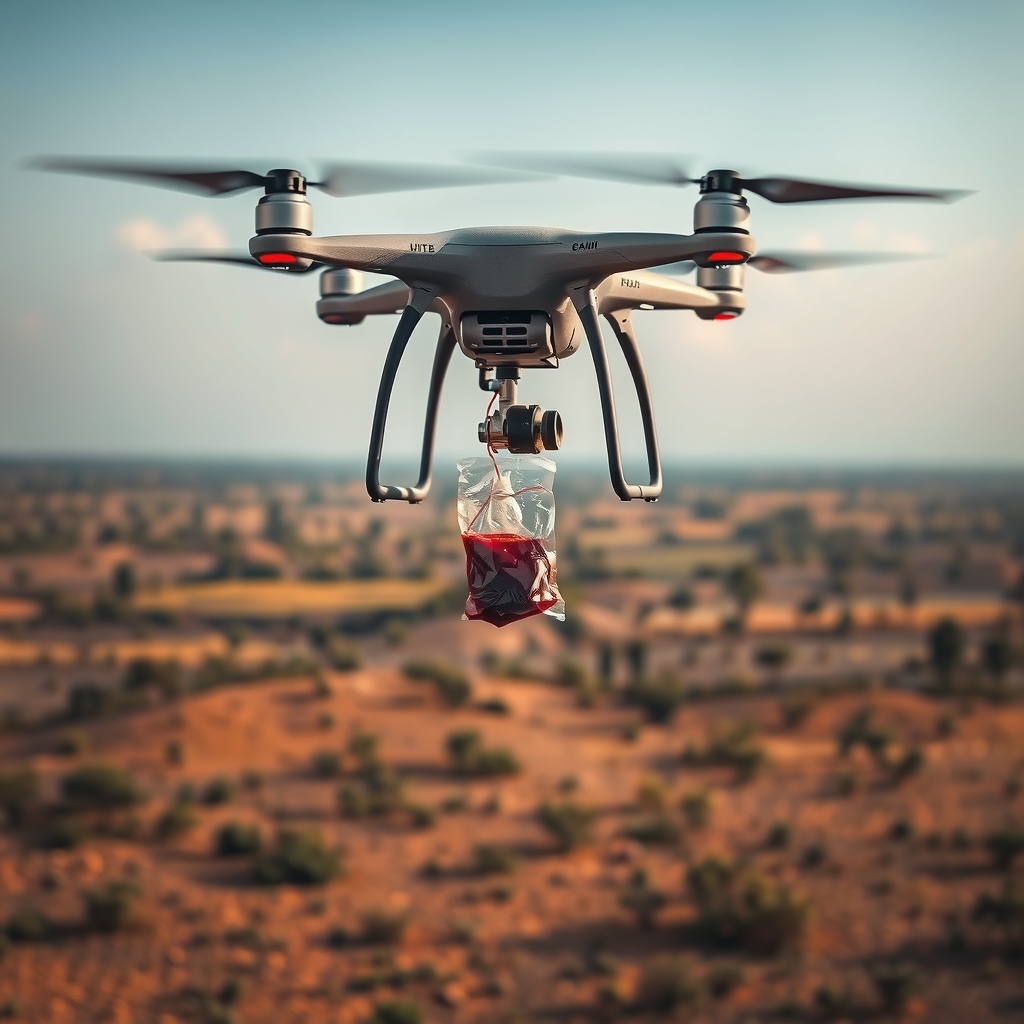
At a rural health facility in Rwanda, a clinic officer receives a text alert, walks outside, and watches a cardboard box float down on a paper parachute. Inside: two units of blood. Time from order to delivery: under fifty minutes. The patient, bleeding after childbirth, receives the transfusion within the hour.
This is not an isolated event. It is infrastructure.
A 2022 study published in The Lancet Global Health measured the effect of drone delivery on blood-product supply across twenty health facilities in Rwanda between 2015 and 2019. The findings were specific: mean drone delivery time was 49.6 minutes, 79 minutes faster than estimated road delivery times and 98 minutes faster than Google Maps estimates. Blood-unit expirations fell by 7.1 units per month per facility—a 67% reduction after twelve months of drone operations. (Source: “Effect of unmanned aerial vehicle (drone) delivery on blood product delivery time and wastage in Rwanda”, Nisingizwe et al., Lancet Global Health, 2022)
The question is not whether drones can carry blood. The question is how Rwanda made them routine, and what that tells other countries about the choices required.
How the model compares
Drone delivery approvals exist in high-income economies, but they remain experimental or confined to narrow pilots. In the United States, the Federal Aviation Administration requires Part 107 waivers for beyond-visual-line-of-sight (BVLOS) flights, and larger commercial operations require Part 135 certification, airworthiness reviews, and operator training. The European Union Aviation Safety Agency uses a risk-based framework; urban or BVLOS operations must pass a Specific Operations Risk Assessment (SORA). Both systems prioritize individual flight approvals over scaled deployment. (Source: “Drone Delivery Regulations: FAA, EASA and Global Rules”, Jinghong Drone)
Rwanda took a different approach: it established national unmanned aircraft regulations, registered the operator, and awarded a government contract for a defined public-health mission. The Rwanda Civil Aviation Authority’s UAS regulations require registration, activity permits, and compliance with safety-management standards, but they permit commercial operations within a clear regulatory category. (Source: “Drones”, Rwanda Civil Aviation Authority; “ICAO model UAS Regulations”, Rwanda Civil Aviation Authority) In 2016, the government contracted with Zipline, a U.S. robotics company, to deliver blood products to remote health facilities using autonomous drones launched from centralized distribution centers. (Source: “Zipline Is Using Drones to Deliver Medical Supplies”, TIME, 2018)
The result: a service that by 2026 dispatched a drone carrying medicine, vaccines, blood, or diagnostic tests on average every fifty seconds, managing virtually all of Rwanda’s pharmaceutical supply deliveries. (Source: “They’re a world leader in using drones for healthcare. But drones can’t do it all”, NPR, 2026)
Why it worked
Three elements distinguish Rwanda’s model from pilot projects elsewhere.
First, the government is the customer. The Ministry of Health contracted for a service—on-demand delivery of blood and medical products—and paid for it as infrastructure, not as a technology demonstration. [The exact payment structure and cost per delivery are not detailed in available sources.]
Second, aviation rules allowed it. Rwanda’s UAS regulations, based on International Civil Aviation Organization (ICAO) guidelines, created categories for commercial drone operation and permitted BVLOS flights under defined safety conditions. The regulations require remote pilots to report incidents within 24 hours and mandate registration and activity permits, but they do not impose blanket prohibitions on autonomous or long-range flights. (Source: “ICAO model UAS Regulations”, Rwanda Civil Aviation Authority)
Third, the use case was singular and urgent. The World Health Organization categorizes hospital blood needs into three levels: emergency (blood required within 60 minutes), certain need, and possible need. Emergency obstetric hemorrhage—the scenario that prompted Rwanda’s program—fits the first category, where every minute counts and the universal blood group O is in constant demand. (Source: “Using unmanned aerial vehicles (drones) to improve access to blood in low‐ and middle‐income countries”, Datta et al., Vox Sanguinis, 2026) Drones optimized for one task—flying blood from a central depot to dispersed clinics—could be certified, insured, and scaled without solving every logistics problem at once.
Where the model has spread
Ghana launched a similar service, also operated by Zipline, delivering blood, vaccines, and emergency medical supplies via drone. A 2024 study published in BMC Health Services Research assessed healthcare professionals’ perceptions of the service, describing it as “one of the first large-scale empirical assessments of healthcare professionals’ perceptions of drone-enabled healthcare logistics in Africa.” The study confirmed awareness and perceived benefits among health workers, though it did not publish time-savings or wastage-reduction data comparable to the Rwanda study. (Source: “Drones in healthcare logistics: Insights from healthcare professionals’ perspective on Zipline delivery services in Ghana”, PMC, 2024)
Tanzania announced plans in 2017 to launch drone delivery of blood, vaccines, medications, sutures, and IV tubes in early 2018, in partnership with Zipline. (Source: “Drone System From Zipline To Launch In Tanzania, Delivering Medical Supplies”, NPR, 2017) [Published outcome data from Tanzania operations were not found in the provided sources.]
Kenya enacted the Civil Aviation (Unmanned Aircraft Systems) Regulations in 2020, creating a legal framework for drone registration, operation, and commercial use. The regulations categorize drones by risk level and require that companies operating drones for long-term commercial purposes be Kenyan-registered entities; foreign operators may apply for temporary permits. At the time of the regulation’s passage, observers noted Kenya’s intention to adopt Rwanda’s model for healthcare delivery to rural areas. (Source: “Kenya Passes Significant Unmanned Aircraft (Drones) Legislation”, DLA Piper Africa / IKM Advocates, 2020; “Unmanned Aircraft Systems (Drones)”, Kenya Civil Aviation Authority)
What a country needs to start
Adoption requires alignment across four domains: regulation, procurement, data infrastructure, and operational design.
Aviation rules. A national civil aviation authority must permit BVLOS commercial drone flights, establish categories for different risk levels, and define registration, pilot certification, and incident-reporting requirements. Rwanda and Kenya have done this; countries without UAS regulations in place must draft them or adapt ICAO model standards.
Procurement authority. The ministry of health (or equivalent) must have the mandate and budget to contract for delivery services as part of the national health system. This is a policy decision, not a technical one.
Health-data systems. The Rwanda model relied on the country’s Health Management Information System to track orders, deliveries, and blood-unit expirations before and after drone adoption. Without digitized stock and demand data, it is difficult to measure whether the service improves outcomes or to manage dispatch efficiently. (Source: “Effect of unmanned aerial vehicle (drone) delivery”, Nisingizwe et al., Lancet Global Health, 2022)
Operational partners. Implementation requires a provider capable of manufacturing or operating drones, training local staff, establishing distribution centers, and maintaining equipment. Rwanda contracted this role; other countries may choose to build in-house capacity, though no examples of government-operated medical drone fleets at scale were found in the sources.
Who must act: ministries of health and civil aviation, working in coordination. Neither can proceed alone.
What the model cannot do
The Rwanda study’s authors call for future research on cost-effectiveness; cost data were not published. (Source: “Effect of unmanned aerial vehicle (drone) delivery”, Nisingizwe et al., Lancet Global Health, 2022) Weather, battery life, payload weight, and range all impose limits. Drones designed for equatorial climates may require modifications for different weather patterns; research on blood-component quality maintenance in varying climates remains incomplete. (Source: “Using unmanned aerial vehicles (drones) to improve access to blood”, Datta et al., Vox Sanguinis, 2026; “Adopting drone technology for blood delivery: a feasibility study”, PMC, 2024) Heavy rain, strong winds, and fog can ground flights. And drones are not a replacement for roads, cold-chain storage, or health workers—they are a supplement for time-critical, low-weight deliveries where speed justifies the investment.
The Rwanda case demonstrates that medical drones are not experimental. They are a procurement decision. The countries that adopt them next will not be those with the most advanced technology, but those whose health and aviation authorities agree on rules, budget, and purpose.



No Comments
Join the DiscussionBe the first to join the discussion!