

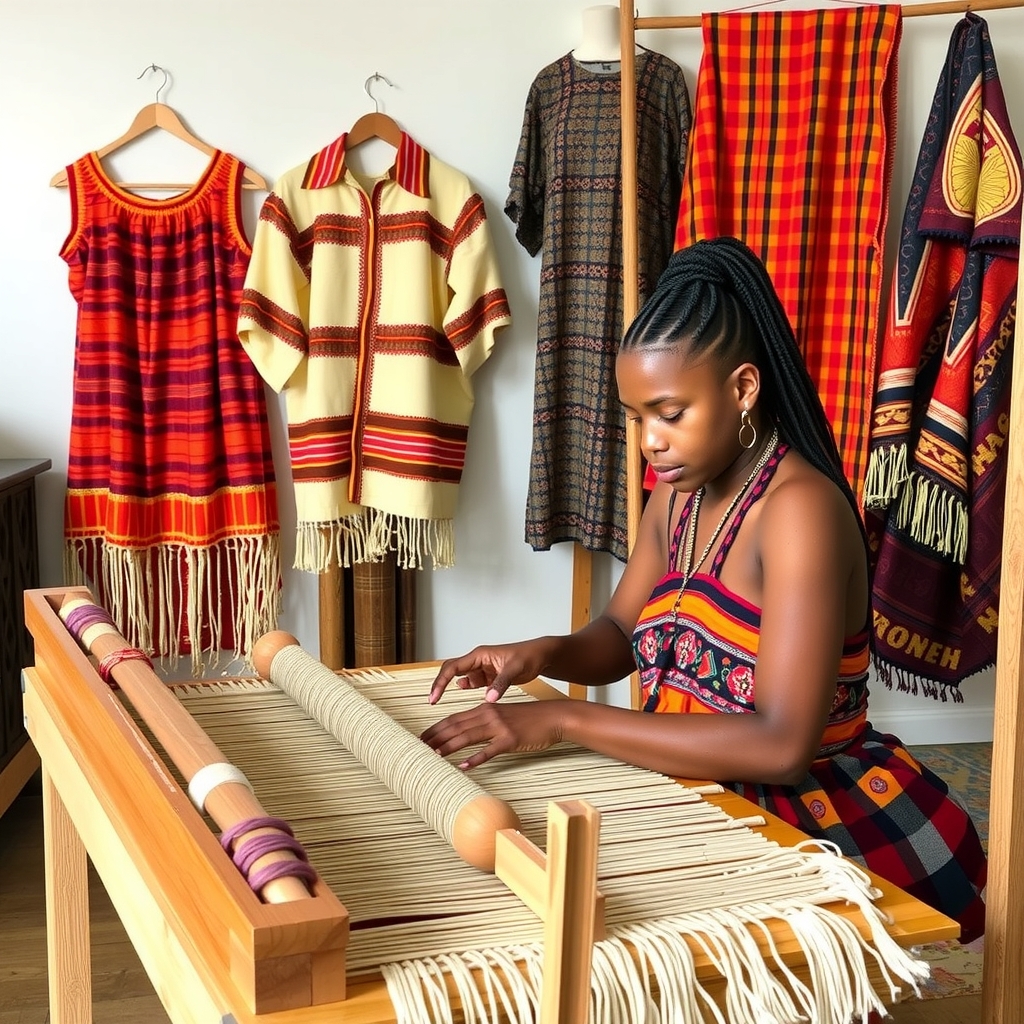
At the loom in Bonwire, a young weaver's shuttle moves steadily through warp threads, building kente cloth one interlocking strip at a time. A few minutes' walk away in the same town, printed imitations—factory-made, machine-cut, sold for a fraction of the price—fill market stalls. The juxtaposition frames the central challenge facing Ghana's kente weavers: how to turn centuries of technique and a year of legal protection into a defensible livelihood.
In August 2025, kente became Ghana's first protected geographical indication. The Registrar-General's Department, working with the World Intellectual Property Organization, launched the designation the following month, tying the name "kente" to handwoven cloth produced in specific Ghanaian communities—Bonwire, Adanwomase, Agotime Kpetoe, Agbozume, and Tafi Atome—using time-honored techniques (Source: Registrar General's Department). The move followed UNESCO's December 2024 inscription of kente weaving on its Representative List of the Intangible Cultural Heritage of Humanity (Source: UNESCO; Africanews).
Export data suggest early traction. The Ghana Export Promotion Authority reported kente export value of US$38,901.83 in 2024, up from US$6,256 in 2023—a 522 per cent increase from a small base (Source: Bird Story Agency; GEPA). The industrial arts and crafts subsector as a whole recorded 23 per cent export growth in 2024, with kente's growing presence in contemporary fashion at national and international events encouraging artisans to see the cloth as both cultural heritage and an economic asset.
A benchmark: Harris Tweed's path from protection to market
Ghana is not the first to marry handwoven cloth to legal protection. Harris Tweed, produced by islanders in Scotland's Outer Hebrides, is defined and protected by the Harris Tweed Act 1993. The legislation enshrines quality standards and ties the name to cloth handwoven at islanders' homes, finished in the Outer Hebrides, and made from pure virgin wool dyed and spun in the same region (Source: Wikipedia; American Bar Association).
The Act grants the Harris Tweed Authority enforcement powers and allows industry members to seek injunctions against misuse of the name. While the Act's territorial reach is limited to the United Kingdom, the Authority maintains a worldwide portfolio of registered marks in territories where the cloth is sold or where mills anticipate emerging markets. The system has had a deterrent effect within the UK textile industry and built a foundation for a brand that commands premium pricing globally despite—and perhaps because of—its adherence to slow, place-bound production (Source: American Bar Association).
Harris Tweed's trajectory offers one model: legal definition backed by an empowered authority, enforcement mechanisms both domestic and international, and a collective commitment to standards that justify price. The question for kente is whether Ghana's institutions and weavers can replicate that architecture.
What holds weavers back
Four constraints emerge from recent reports and weaver statements.
First, imitations. Factory-printed kente-type cloth, much of it imported, undercuts handwoven prices and confuses buyers. In February 2026, Bonwire weavers called on the government to impose stricter controls on fake and printed kente fabrics, describing the influx as a major threat to their livelihoods (Source: CitiNewsroom; Adomonline). One academic study noted that mass production and copying of kente by countries including China contributed to a decline in Ghana's textile industry revenue from approximately US$179.7 million in 1994 to about US$53.5 million by 2011—a roughly 70 per cent drop (Source: Oxford Academic, Journal of Intellectual Property Law & Practice).
Second, unregistered artisans and the absence of collective standards. The geographical indication ties the kente name to place and technique, but implementing it requires knowing who is authorized to weave and market under that name. A "book of specifications"—the detailed technical standard that would define authentic kente for enforcement and market purposes—is reportedly still in draft (Source: Bird Story Agency).
Third, costly imported yarn. Weavers rely on silk, cotton, or rayon thread, much of it imported, raising production costs and thinning margins (Source: UNESCO).
Fourth, the institutional gap. A national kente weavers' association has been formed but not yet launched. Without a functioning collective body to manage quality, resolve disputes, and coordinate marketing—roles played in Bonwire and other weaving towns by chief weavers at the community level—scaling protection to a national and export market remains difficult (Source: Bird Story Agency; UNESCO).
What would build the market
Five elements recur in expert analysis and weaver appeals as prerequisites for turning protection into revenue.
Registration and enforcement. The geographical indication is only as strong as the system that verifies compliance and penalizes misuse. This requires the Registrar-General's Department to finalize regulations and the book of specifications, establish a registry of authorized weavers, and create an enforcement mechanism—potentially including traceability systems such as QR codes linked to authentic pieces—that can operate both within Ghana and in export markets (Source: HBTV Ghana). International enforcement will require registration of the kente mark in key markets, as the Harris Tweed Authority has done.
Launch and empowerment of the weavers' association. The association would serve as the collective voice and quality gatekeeper, setting standards, training new weavers, and negotiating with buyers. In the Harris Tweed model, an industry liaison group brings together mill owners, weaver representatives, officials, funding bodies, and buyers to discuss issues facing the industry (Source: Wikipedia). A parallel structure in Ghana could coordinate the transition from ad hoc production to a managed, branded supply chain.
Local yarn spinning. Reviving domestic yarn production would reduce input costs, improve margins, and strengthen the claim that kente is a fully Ghanaian product. [No source details current capacity or investment plans for local spinning.]
AfCFTA market access for authentic kente. The African Continental Free Trade Area, launched in 2021, offers a single market of 1.3 billion people. Geographical indications can make goods from regional economic communities more competitive by ensuring product quality and enabling regional value chains (Source: ICOYACA Africa). One analysis suggests AfCFTA rules of origin could be used to attract investment and spur production, though it cautions that policymakers must ensure those rules do not undermine existing local textile production by turning the continent into a market for third-country goods (Source: ODI working paper). For kente, preferential access under AfCFTA—if tied to the geographical indication—could open continental demand for authenticated handwoven cloth while excluding printed imitations.
Marketing and buyer education. Consumers in Ghana, the diaspora, and international markets need to understand the difference between handwoven kente and prints, and the geographical indication offers a tool to make that distinction legible. Retailers in diaspora hubs such as London report that customers want to know they are supporting source communities, but verification has been difficult (Source: HBTV Ghana). A transparent labeling and traceability system would meet that demand.
Who must act
The Registrar-General's Department holds the regulatory lever: finalizing the book of specifications, launching the registry, and enabling enforcement. The Ghana Export Promotion Authority can provide business support, market intelligence, and trade facilitation for registered weavers. The weavers' association, once launched, must set and police standards, train members, and build the collective discipline that underpins premium pricing. And policymakers can use AfCFTA negotiations to secure preferential access for authenticated kente, linking protection to market expansion.
What is clear is that legal recognition has arrived, export figures are rising from a low base, and the infrastructure to translate protection into widespread prosperity—registration, collective organization, enforcement, yarn supply, and continental market access—remains under construction. The printed imitations in Bonwire's market are not an external threat to be lamented. They are the measure of the work still to be done.



No Comments
Join the DiscussionBe the first to join the discussion!