

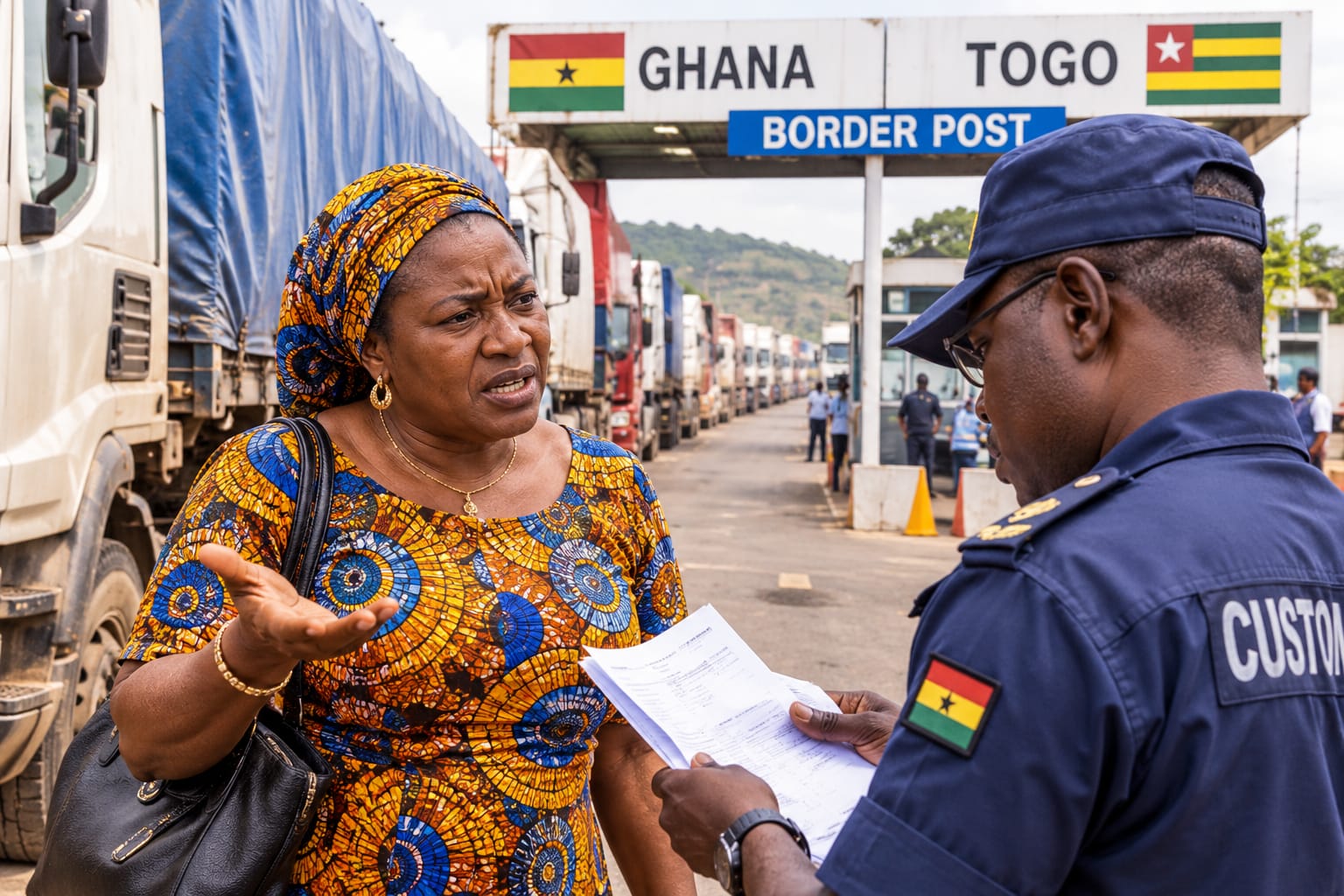
Comfort Mensah leaves Aflao just after five in the morning, her small truck loaded with textiles bound for Lomé. The cargo is worth about 15,000 Ghana cedis. By her own estimate, the journey of thirty-five kilometres should take forty minutes on an empty road. It will take closer to three hours.
She carries an invoice, a packing list, and a certificate of origin to claim duty-free treatment under the ECOWAS Trade Liberalisation Scheme. She also carries cash in three currencies: cedis for payments on the Ghanaian side, CFA francs for the Togolese side, and a reserve in case the exchange rate at the border is poor. Before she reaches the checkpoint, she will stop twice—once for an identity check, once for a document inspection—and each stop will cost time and a payment she describes as "customary."
At the border itself, she presents her documents to Ghanaian customs, waits for clearance, then crosses into Togo and presents them again. The same information, entered twice. The same cargo, inspected twice. If the officer on either side is not satisfied, or if the queue is long, the wait stretches. She exchanges cedis for CFA francs at a bureau near the crossing; the rate is worse than the interbank rate by about six per cent, but it is the only practical option. By mid-morning she is through, her margin reduced by fees, time, and exchange costs that do not appear on any tariff schedule.
What the agreements already allow
Ghana and Togo are both members of the Economic Community of West African States, which established the ECOWAS Trade Liberalisation Scheme to permit duty-free movement of qualifying goods between member states. Under the scheme, unprocessed goods and traditional handicrafts circulate free of import duties and quantitative restrictions; industrial products are eligible for preferential treatment if they meet ECOWAS rules of origin. The scheme has been operational since the 1990s, revised in 2018 to simplify origin procedures.
Ghana joined the African Continental Free Trade Area's Guided Trade Initiative in 2022, one of seven countries selected to test AfCFTA trading documents and procedures on pilot shipments. The GTI assisted those shipments through customs clearance, including reduced tariff treatment under the AfCFTA in receiving countries. For goods already moving duty-free under ECOWAS rules, however, the AfCFTA's tariff liberalisation adds little. The value lies elsewhere: in the ambition to harmonise procedures, digitise documentation, and establish mechanisms to report and resolve non-tariff barriers.
[Unverified—no source found for the number of checkpoints or payments specifically on the Aflao–Lomé route. Borderless Alliance cites "about 85 checkpoints" on the Tema–Paga corridor, but this is a different route and the figure is unsourced.]
The trader's cost is not the tariff she does not pay. It is the time she loses, the forms she duplicates, the currency she converts at a loss, and the payments—official and otherwise—that accumulate between loading and delivery.
The same journey in a working single market
Inside the European Union's single market, a comparable shipment from one member state to another crosses no customs border. The EU eliminated internal customs controls by combining a customs union—member states apply a common external tariff, so there is no incentive to route goods through the lowest-tariff country—with a single market that harmonises the rules governing what can be bought and sold. A lorry loaded in one EU country and destined for another requires no border inspection, no separate customs declaration, no currency conversion.
One consolidated entry serves the entire market. Some goods enter bonded storage with duty suspended, then move to customers as domestic shipments. The border is crossed once, at the wholesale level, not on every individual transaction.
The Chirundu One Stop Border Post between Zambia and Zimbabwe offers a regional example. Officers from both countries work on both sides of the border to perform their respective functions in the same location, reducing the need for travellers and cargo to stop twice. The model aims to cut transit times, lower costs, and streamline procedures. Clearance processes that once required multiple stops now happen in a coordinated sequence at a single site.
Neither model is a template for direct replication, but both illustrate the same principle: borders slow trade not because of tariffs, but because of duplication, friction, and the absence of shared systems.
Why agreements on paper have not reached this border
ECOWAS protocols permit duty-free trade, but protocols do not execute themselves. National customs authorities operate under their own procedures, often requiring separate filings, separate inspections, and separate approvals even when the legal framework allows otherwise. Information systems are not linked. A certificate issued in Ghana may be recognised in principle by Togo, but it must still be presented, verified, and recorded again.
Currency conversion remains a persistent cost. Ghana uses the cedi; Togo and other members of the West African Economic and Monetary Union use the CFA franc, which is pegged to the euro and managed by a different central bank. Traders moving between the two markets must convert currency at border bureaux, where spreads are wide and liquidity is uneven. The Pan-African Payment and Settlement System, launched in 2022, is designed to enable cross-border payments in local currencies without the need for hard-currency intermediation, but its reach is not yet universal and adoption by traders and banks remains gradual.
Enforcement is inconsistent. The ECOWAS scheme specifies that qualifying goods should move freely, but it does not specify common inspection standards, common digital systems, or penalties for unwarranted delays. When a shipment is delayed, the trader has limited recourse. The AfCFTA Secretariat operates an online mechanism for reporting non-tariff barriers at tradebarriers.africa, but awareness of the tool among small traders is low, and the process for follow-up is not yet institutionalised.
Unofficial payments persist. Research on cross-border fish traders at Aflao during the COVID-19 pandemic notes that most survey participants used the official checkpoint before the pandemic, though some also used unofficial routes. Payments described as "customary" are not documented in official statistics, but traders consistently report them. These costs are not incidental; they are structural features of a system in which formal rules exist but routine practice diverges.
The same trip under a single market
The trader's journey could look different. One digital form, submitted before departure, shared in real time between Ghanaian and Togolese customs. One physical inspection, coordinated so that both authorities clear the cargo in the same place, at the same time, eliminating the need to stop twice. Payment routed through PAPSS, allowing the trader to send cedis that arrive as CFA francs without visiting a bureau or absorbing a six-per-cent spread. A mechanism to report barriers—checkpoints without clear legal basis, delays without explanation, payments without receipt—that triggers investigation and correction.
None of these elements requires new agreements. They require implementation: linking customs IT systems, training officers in joint procedures, expanding PAPSS coverage among commercial banks and traders, and operationalising the AfCFTA's barrier-reporting tool with timelines and accountability.
Responsibility is shared. Ghana Revenue Authority and Togo's Office Togolais des Recettes must align procedures and invest in interoperability. ECOWAS, as the existing regional body, must enforce its own trade liberalisation scheme and support member states in harmonising systems. The AfCFTA Secretariat must ensure that the reporting mechanism is accessible, that complaints are acted upon, and that traders know it exists.
A single market is not a declaration. It is a system: shared rules, shared infrastructure, shared enforcement, and a commitment to treat a cross-border shipment as a domestic one. That system does not yet exist between Aflao and Lomé, but every component needed to build it is within reach.



2 Comments
Join the Discussion[…] Aflao to Lomé: What Slows Ghana–Togo Trade Today […]
[…] Aflao to Lomé: What Slows Ghana–Togo Trade Today […]