

The Akan people of West Africa have a profound proverb: “Anoma entoa ogya a, ɔbɛyɛ dɛn na ne mfeɛ asɔ?”, translated literally as, “If a bird does not fly into the fire, how can its feathers catch light?” For centuries, Eurocentric historians, driven by imperialist agendas and racial chauvinism, wrapped African history in a dense fog of deliberate amnesia. They claimed that Africa was a “dark continent” devoid of written history until European colonial powers graciously arrived with the gift of the Latin alphabet.
This claim is not just an error of history; it is a foundational lie of the colonial enterprise. To justify the theft of land, resources, and human beings, imperialists had to invent the myth of the “savage”, a human being supposedly living without memory, without structure, and without writing.
But history cannot be erased by the ink of the colonizer. When we look at the actual archaeological, linguistic, and historical record, the truth catches light. Long before European ships ever sighted the coasts of Africa, the continent was home to some of the oldest, most sophisticated, and structurally diverse writing systems in human history. From the Horn of Africa to the deep forests of the West, and from the sands of the Sahara to the banks of the Nile, African societies engineered brilliant visual technologies to record laws, map the cosmos, and preserve their cultures.
Dismantling the Imperialist Framework: Alphabet Supremacy
Before examining the evidence, we must dismantle the intellectual trap set by racial chauvinists: Alphabet Supremacy.
Eurocentric academia long insisted that a society is only “civilized” if it possesses a phonetic alphabet where single letters equal single sounds. This narrow definition was manufactured precisely because it allowed Western powers to dismiss alternative, often more complex, forms of intellectual literacy as “mere symbols” or “primitive art.”
Modern linguistics rejects this bias. A writing system is any structured visual technology used to systematically record and transmit information. Human genius has two primary pathways to achieve this:
- Phonetic Systems (Phonograms): Writing that captures the sound of the voice (e.g., Alphabets, Abugidas, Syllabaries).
- Semantic Systems (Ideograms/Logograms): Writing that captures the meaning of the mind directly, bypassing spoken sound entirely to map concepts, relationships, and philosophies.
Pre-colonial Africa did not just excel in one of these pathways; it mastered both.
The Irrefutable Regional Evidence
To claim that Africa lacked writing is to ignore the geography of an entire continent. The evidence spans every major region, proving that literacy was an indigenous African phenomenon.
1. Northeast Africa: The Cradle of the Script
The Nile Valley holds the oldest receipts of human literacy. While Eurocentric education systems often attempt to racially detach Egypt from the rest of the African continent, ancient Egyptians were indigenous Africans whose writing system emerged directly from African cultural contexts.
- Egyptian Hieroglyphs (c. 3200 BC): Developed along the Nile, this monumental script combined logograms (pictorial words) and phonographic sounds. It was used to administer an empire, calculate engineering marvels, and record complex theological treatises long before the founding of Rome or ancient Greece.
- The Meroitic Script (c. 300 BC): Further south, in the Kingdom of Kush (modern-day Sudan), Kushite scholars developed an entirely independent, highly advanced writing system to record the Meroitic language. Unlike the complex hieroglyphic system of Egypt, Meroitic was a syllabic alphabet consisting of 23 signs. It existed in two forms: a formal hieroglyphic style for royal monuments and a swift, elegant cursive script for everyday governance, trade, and legal administration.
2. East Africa: The Living Grid of Ge’ez
In the Horn of Africa, the Aksumite Empire (modern-day Ethiopia and Eritrea) developed a writing system that is not only ancient but remains actively used today: the Ge’ez script (c. 400 BC).
Ge’ez is classified in modern linguistics as an abugida. It operates with mathematical precision. Every base character represents a consonant, and the shape of that character is physically modified (by adding a stroke, a loop, or a ring) to indicate the accompanying vowel sound.
- The Structure: The consonant H is written as ሀ (“ha”). By adding a small loop to its right leg, it becomes ሁ (“hu”). By shortening its left leg, it becomes ሂ (“hi”).
- The Impact: With 28 core consonants modified across 7 vowel positions, Ge’ez provides a flawless 182-character structural grid capable of recording any spoken human thought word-for-word. This script was used to write complex international treaties, Christian and Jewish religious texts, and vast historical chronicles centuries before European missionaries set foot in East Africa.
3. West Africa: The Ideographic Genius of Nsibidi and Adinkra
Imperialist history books frequently target West Africa, claiming its empires were entirely oral. This is flatly contradicted by the existence of Nsibidi and Adinkra.
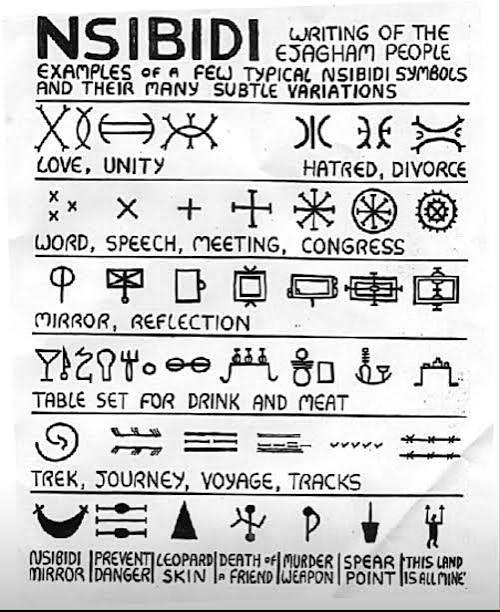
- Nsibidi (c. 400–500 AD): Developed by the Ejagham people of southeastern Nigeria and western Cameroon, Nsibidi is a sophisticated system of hundreds of ideographic and logographic symbols. Long before colonization, Nsibidi was a fully functioning script used to record court verdicts, write public warnings, map out spiritual topographies, and even compose long, multi-layered love letters.
- The Legal Logic: In a traditional Cross River court case, Nsibidi symbols were drawn on the ground or on walls to record a permanent, legally binding verdict. Two lines drawn close together meant unity; a thick structural stroke between them meant an official divorce. It was a script designed for the mind, translating human relationships directly into geometric law without needing to spell out phonetic syllables.
- Adinkra Symbols (c. 1200 AD): Created by the Akan and Gyaman peoples of Ghana and Côte d’Ivoire, Adinkra is a visual language of compressed philosophy. These are not random decorative patterns. Each geometric icon acts as a hyperlink to a vast, standardized spoken proverb, legal code, or historical truth. To wear an Adinkra cloth was to project a highly legible, public sentence about your political stance, emotional state, or philosophical outlook.
4. North Africa: The Geometric Resilience of Tifinagh
Across the vast expanse of North Africa, the indigenous Amazigh (Berber) populations developed the Libyco-Berber script, which evolved into Tifinagh (c. 300 BC).
Tifinagh is a highly distinctive, sharply geometric alphabet composed of squares, circles, dots, and parallel lines. Carved into rock faces from Libya to Mali, this script survived waves of Roman, Vandal, and Arab invasions. The Tuareg people preserved it across millennia in the Sahara desert, using it to write personal letters, mark territory, and record histories, proving that the African interior possessed its own autonomous alphabetic traditions long before Western intervention.
5. Central and Southern Africa: The Mathematical Grid of Lusona
In the democratic Republic of Congo, Angola, and Zambia, the Chokwe and Luchazi peoples developed Lusona (singular: Sona).
Lusona is a profound graphic narrative system rooted in advanced mathematics. A narrator creates a perfectly symmetrical grid of dots in the sand and draws a single, continuous, looping line around them without ever lifting their finger or intersecting the line. This geometric matrix acts as an immutable mnemonic script. Each completed drawing records a precise historical event, a complex kinship structure, or a scientific observation about local ecosystems.
Comparative Matrix of Pre-Colonial African Scripts
| Script Name | Geographic Region | Approximate Origin | Script Typology | Primary Functions |
|---|---|---|---|---|
| Egyptian Hieroglyphs | Nile Valley (Egypt) | c. 3200 BC | Logographic + Phonetic | Royal decrees, religion, imperial administration |
| Ge’ez | Horn of Africa (Ethiopia/Eritrea) | c. 400 BC | Abugida (Syllabic-Alphabetic) | State chronicles, religious texts, international law |
| Meroitic | Kingdom of Kush (Sudan) | c. 300 BC | Syllabic / Alphabetic | Trade records, everyday governance, legal decrees [2] |
| Tifinagh | North Africa / Sahara | c. 300 BC | Alphabetic | Territorial marking, personal records, histories |
| Nsibidi | Cross River Region (Nigeria/Cameroon) | c. 400 AD | Ideographic / Logographic | Judicial verdicts, sacred codes, personal letters |
| Adinkra | West Africa (Ghana/Côte d’Ivoire) | c. 1200 AD | Ideographic / Visual Language | Philosophical discourse, political status, historical records |
| Lusona | Central Africa (Angola/Congo) | Ancient | Graphic / Mnemonic Matrix | Mathematical modeling, historical narratives, kinship logs |
The Ultimate Convergence: Why the Myth Was Maintained
If the evidence of African writing systems is so vast and structurally indisputable, why does the lie of an exclusively “illiterate Africa” persist?
The answer is found in another brilliant African proverb: “Koki nwa mbe, onye ga-ama mgbe ọ gbara afwụ?”, an Igbo proverb meaning, “If the tortoise does not speak, who will know when its shell is cracked?”
Imperialism functioned by systematically cracking the shells of African societies and then declaring that the tortoise never had a shell to begin with. When European colonizers encountered these scripts, they actively suppressed them:
- In Nigeria, British colonial administrators banned Nsibidi, branding it “witchcraft” and “subversive,” forcing the sacred societies that maintained it underground.
- In Ghana, the profound semiotic text of Adinkra was downgraded in colonial reporting to “quaint textile patterns.”
- In East Africa, Eurocentric linguists spent decades trying to claim that Ge’ez must have been invented by wandering South Arabians, because their racial chauvinism could not accept that dark-skinned Africans could engineer a flawless typographic grid.
The Western world weaponized a single definition of writing to invalidate all others. They ignored the fact that while the West was using alphabets to write words, Africa was often using highly advanced graphic systems to write ideas directly.
Conclusion
The historical record is clear, objective, and completely irrefutable. Africa was never a blank slate waiting for the European pen. The continent possessed a magnificent tapestry of literacy: from the phonetic precision of Ge’ez to the ideographic depth of Nsibidi, and from the monumental clarity of Hieroglyphs to the mathematical elegance of Lusona.
To look upon pre-colonial African writing systems is to realize that African civilizations did not just speak; they wrote, they calculated, they codified, and they remembered. The feathers of the African bird have always held their own light, it is simply time for the rest of the world to stop closing its eyes to the fire.



No Comments
Join the DiscussionBe the first to join the discussion!