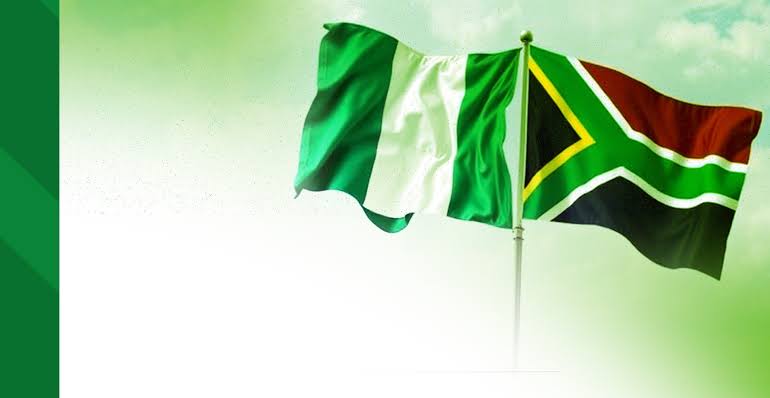
An old Yoruba proverb warns, “When a handshake passes the elbow, it has become another thing entirely.” Similarly, the Zulu people say, “A single finger cannot crush a louse.” These pieces of traditional African wisdom capture a grim reality in modern African geopolitics: the historic and once-indivisible bond between the continent’s two largest heavyweights, Nigeria and South Africa, has slipped from a warm embrace into a dangerous chokehold.
To understand how the continent’s two most exceptional sibling nations reached this impasse, one must look at the story of the household they share. Born to the same great matriarch, Mother Africa, they were once two towering brothers: the Elder and the Younger.
The Elder brother (Nigeria), flamboyant and charismatic, found his footing early. When the Younger brother (South Africa) fell into a long, brutal captivity under a cruel neighbor, the Elder brother did not hesitate. He sacrificed his own allowance, gave the Younger brother his clothes, issued him passports to see the world, and fought tirelessly at the village council to secure his freedom. There was no transactional demand, just pure, unadulterated fraternal love. When the Younger brother was finally freed, they embraced, building an empire together and launching businesses as the undisputed pillars of the household.
However, as time passed, the dynamics in the compound shifted. The Younger brother, still healing from the trauma of his captivity, faced immense pressure to rebuild his personal wealth, yet struggled to distribute it fairly among his own children. Meanwhile, many of the Elder brother’s energetic children moved into the Younger brother’s yard to trade and build lives.
Quiet resentments began to simmer. When a formal audit of the family estate revealed that the Elder brother’s total wealth had technically surpassed the Younger brother’s, the Younger brother felt a quiet, burning resentment at being leap-frogged. Petty arguments broke out over everything from who threw the best parties to who excelled at sports. Corporate rivalries soured their business meetings. Before physical violence ever broke out, the relationship had devolved into a fraught, passive-aggressive cold war. The deep-seated gratitude the Younger brother once held was replaced by amnesia. He began looking at the Elder brother’s children not as cousins who helped build the estate, but as aggressive intruders stealing food from his children’s plates. The trust was gone.
To look at Nigeria and South Africa today is to watch two giant structural pillars holding up the same roof. If they lean toward each other in harmony, the entire African mansion stands secure, stable, and prosperous. But if those pillars begin to fracture and pull apart, the roof threatens to cave in on everyone. Today, that metaphorical roof is creaking under the weight of xenophobic violence, deep socio-economic grievances, and retaliatory diplomatic standoffs.
The Modern Migration Realities: Data, Protests, and Repatriations
Public rhetoric often diverges wildly regarding the true size of the Nigerian diaspora residing in South Africa. Depending on the source, population figures vary considerably:
- Official Data: Documented Empirical data projects a population of Nigerian-born residents at approximately 30,000, consisting about 2% of the country’s foreign-born community.
- Higher Estimates: Unofficial community and diaspora estimates, often cited by organizations like the Nigerian Union South Africa (NUSA), range significantly higher, between 500,000 and 800,000. These higher figures attempt to account for unregistered, undocumented, or illegal migrants, though demographers note they lack firm statistical backing. In previous diplomatic assessments, Nigeria’s High Commission also noted that up to 500,000 citizens could fall under the undocumented category.
- The Broader Migrant Landscape: Officially, the vast majority of South Africa’s estimated 2.4 to 2.6 million total immigrants arrive from neighboring SADC regions:
- Zimbabwe: ~1,012,000
- Mozambique: ~417,000
- Lesotho: ~228,000
- Malawi: ~199,000
The 2026 Evacuations:
Following a surge of anti-foreigner rallies in Pretoria and Johannesburg, the Nigerian government launched a coordinated, state-assisted voluntary repatriation scheme. By mid-2026, Nigeria had officially repatriated more than 1,000 citizens who expressed interest in leaving due to insecurity or an inability to regularize their papers. This included dedicated flights operated by carriers like Air Peace alongside Department of Home Affairs-monitored flights.
The Foundations of Brotherhood: When Nigeria Issued Passports to the ANC:
The formal architecture of this relationship began with a shared African identity. Long before modern statehood, early interactions saw South African Christian missionaries arriving in Nigeria’s Benue region. However, the true crucible of their brotherhood was forged in the fires of the anti-apartheid struggle.
During the darkest years of apartheid, the white-minority regime routinely revoked the passports and travel documents of Black activists, effectively trapping them within South Africa or limiting them to unstable refugee papers. To shatter this blockade, the Nigerian government took a radical step: it weaponized its foreign policy and issued more than 300 Nigerian travel passports to prominent South African anti-apartheid freedom fighters fleeing minority rule.
These passports transformed exiled activists into diplomatic agents, giving them the requisite legal cover to travel globally, establish international African National Congress (ANC) bureaus, seek education, and lobby world governments to impose sanctions on Pretoria.
While former President Thabo Mbeki (who lived in exile in Nigeria from 1977 to 1984) is the most famous recipient, Nigeria served as a sanctuary for a generation of the ANC leadership.
Legendary ANC figures, commanders of the armed wing Umkhonto we Sizwe, and pan-Africanist organizers were granted free passage. Future diplomats, regional representatives, and academic exiles traveled under the protection of the green-white-green passport issued out of Nigerian diplomatic hubs like the High Commission in Botswana. Additionally, in 1963, prominent figures like Nelson Mandela were hidden and hosted secretly by Nigerian ministers such as Mbazulike Amaechi to protect them from colonial and apartheid police tracking.
When South Africa finally transitioned to multi-party democracy, ordinary Nigerians celebrated it as their own victory.
The Global Arena: Leading the International Advocacy
Nigeria did not merely help from the sidelines; it spearheaded the international movement to isolate apartheid South Africa legally and economically. Despite being thousands of miles from the frontline, Nigeria’s aggressive anti-apartheid foreign policy earned it the title of an honorary “Frontline State”.
Nigeria’s Anti-Apartheid Timeline
1961 (April)Imposed absolute trade embargo and economic sanctions.
1962–1994Formed and chaired the UN Special Committee Against Apartheid.
1976 (Soweto)Created the Southern African Relief Fund (SARF).
1977 (August)Hosted the landmark UN World Conference in Lagos.
1970s–1980sLed global boycotts of the Olympics and Commonwealth Games.
The Diplomatic Milestones
- The 1961 Commonwealth Walkout: Just months after securing its own independence from Great Britain, Nigeria took its first major stand on April 11, 1961, by enforcing a total trade boycott against South Africa. At the 1961 Commonwealth Conference, Nigerian leadership led a ferocious diplomatic charge that ultimately forced South Africa to withdraw its membership from the Commonwealth.
- 30 Years at the United Nations: Nigeria was the driving force behind the creation of the United Nations Special Committee against Apartheid in 1962. Uniquely, Nigeria chaired this vital committee continuously for 30 years until the dawn of South African democracy in 1994, orchestrating global resolutions and blocking Western attempts to dilute anti-apartheid policies.
- The 1977 Lagos World Conference: From August 22–26, 1977, the Nigerian federal government, in collaboration with the United Nations and the Organization of African Unity (OAU), hosted the historic World Conference for Action against Apartheid in Lagos, Nigeria. Attended by global leaders and liberation icons like Oliver Tambo, the conference culminated in the Lagos Declaration for Action against Apartheid, a definitive framework that mobilized international law to declare apartheid a flagrant violation of human rights.
With Direct Action, Financial Aid and Mobilization,
Nigeria’s resistance went far beyond speeches. The country leveraged its state resources and mobilized other African leaders to enforce real consequences:
- Economic Sacrifices: Nigeria nationalized the local assets of global conglomerates like British Petroleum (BP) and Barclays Bank to penalize them for supplying oil and buying bonds from the apartheid regime. Furthermore, Nigeria’s strict refusal to sell oil to Pretoria during the height of the oil boom cost the Nigerian treasury an estimated billions of dollars in potential revenue.
- The Southern African Relief Fund (SARF): Established by the military government in 1976, this fund relied not just on the state, but on everyday citizens. The Nigerian government established the National Committee Against Apartheid (NACAP) and created mandatory “South Africa Relief Fund,” where Nigerian civil servants contributed fractions of their salaries, and university students skipped meals to donate. The fund raised millions to provide free higher education, housing, and structural support to thousands of exiled South African students.
- Sports Diplomacy: Nigeria successfully mobilized 32 non-aligned nations from Africa, Asia, and the Caribbean to completely boycott the 1976 Montreal Olympics and the 1986 Commonwealth Games. This effectively barred apartheid South Africa from the international sporting arena and punished countries that maintained sporting ties with the regime.
A Continental Coalition: Regional Efforts Beyond Nigeria:
While Nigeria acted as the primary financial juggernaut and diplomatic spearhead from West Africa, its campaign was mirrored by a broad, highly coordinated coalition of nations spanning every region of the continent. Nigeria took the lead in the global arena, other African regions provided critical support:
- Southern Africa (The Frontline States): Nations sharing immediate borders with the regime, such as Zambia, Tanzania, Botswana, and later Mozambique and Angola, bore the direct brunt of apartheid’s military wrath. Zambia’s Lusaka served as the operational headquarters for the ANC in exile, while Tanzania hosted major training camps for Umkhonto we Sizwe. These nations suffered cross-border raids, assassinations, and economic destabilization by the Pretoria regime, yet refused to close their borders to South African freedom fighters.
- West Africa (Beyond Nigeria): Nations like Ghana under Kwame Nkrumah provided early intellectual, passport, and financial backing to the ANC. Later, countries like Senegal played a highly specific diplomatic role, notably hosting the historic 1987 Dakar Conference where exiled ANC leaders met face-to-face with white South African liberals to map out a democratic future.
- East Africa: Ethiopia provided crucial military foundation work, including giving Nelson Mandela his initial guerrilla warfare training and an Ethiopian passport in 1962. Concurrently, Kenya and Uganda regularly utilized regional radio networks to broadcast anti-apartheid messaging and provided high-level diplomatic support within East African trade blocs.
- North Africa: Algeria became a vital military training ground and ideological sanctuary for the ANC, with Mandela famously receiving training there in the early 1960s. Egypt under Gamal Abdel Nasser opened Cairo as a diplomatic and media hub for South African liberation movements, broadcasting their struggle to Europe and the Middle East.
- Central Africa: Nations like the Republic of the Congo and others within the region routinely backed OAU resolutions, using their voting blocs to ensure that no African nation broke the continental trade and diplomatic embargo against the white-minority government.
In Their Own Words: Factual Historical Quotes:
The depth of this historical alliance is best captured by the anti-apartheid leaders who lived through it.
During his address to the United Nations Special Committee Against Apartheid, the committee chaired continuously by Nigerian diplomats, ANC President Oliver Tambo laid bare the brutal reality of their struggle and the necessity of global allies, stating:
“No one can doubt any longer now that life for the African in South Africa is not life. If it is, it is worth nothing. But we promise that in that event no other life in South Africa is worth anything, white or not white. Let the United Nations and the world, therefore, save what it can.”
When Nelson Mandela was finally released from prison, his first international tour in May 1990 brought him straight to Nigeria. Standing before cheering crowds in Lagos, Mandela expressed profound gratitude for the billions of dollars worth of cumulative sacrifices made by the citizens and government of Nigeria. Reflecting on how Nigeria’s unyielding solidarity directly shattered his prison walls, Mandela noted:
“The warm support we have received from the people of Nigeria… has been a source of great inspiration to us. Your solidarity has made it possible for us to stand here today, not just as free individuals, but as representatives of a people on the threshold of their total liberation.”
Mandela openly recognized that the anti-apartheid victory was a success deeply shared by Nigeria, a nation that willingly bore immense economic, diplomatic, and social costs to ensure that South Africa would eventually see freedom.
From Liberation to Xenophobia:
Yet, when the euphoria of liberation settled, a harsh socioeconomic landscape emerged. In the decades following the fall of apartheid, South Africa battled intense domestic challenges, including high unemployment, wealth inequality, and systemic public service deficits.
Concurrently, a lack of local opportunities forced thousands of resourceful Nigerians to migrate southwards. Many established legitimate, highly successful enterprises across South Africa’s formal and informal economic sectors.
Unfortunately, these migration patterns collided with localized frustrations. Local anti-migration groups began scapegoating foreign nationals, falsely accusing them of hoarding jobs, straining public health infrastructure, and driving local crime syndicates.
What followed was a horrific cycle of xenophobic unrest. Recurring in waves, targeted violence has repeatedly erupted in townships like Alexandra, Johannesburg, and Durban. Mob violence, the looting of Nigerian-owned storefronts, physical assaults, and extrajudicial fatalities turned the dream of Pan-African unity into a nightmare.
The friction soon trickled down to citizen-led retaliations. In Nigeria, enraged youth groups and student unions launched public protests, targeting South African corporate juggernauts operating inside Nigeria, such as MTN, Shoprite, and Multichoice.
The Deterioration of Diplomacy
For years, the diplomatic response remained measured, relying on polite, high-level assurances. But diplomacy stops working when words fail to protect lives on the ground. Nigeria has increasingly accused Pretoria of institutional complicity and law enforcement indifference, pointing to a severe failure to investigate, arrest, and prosecute perpetrators of xenophobic violence.
This breakdown has triggered political retaliation. The Nigerian government’s execution of mass evacuations of its citizens from South African cities marked a major turning point. Tensions escalated further when Nigeria’s National Assembly suspended all official legislative visits to South Africa, demanding concrete accountability rather than empty diplomatic platitudes.
Furthermore, Nigerian President Bola Tinubu formally raised the issue before the African Union (AU), warning that unchecked xenophobia threatens the very fabric of continental solidarity. This toxic climate of mistrust has paralyzed bilateral trade and cast a shadow over regional integration.
Patching the Rift: Pragmatic Solutions
To stop the bleeding, both nations must abandon reactionary posturing and adopt structured, long-term diplomatic remedies.
- Revitalize the Bi-National Commission (BNC): The Nigeria-South Africa Bi-National Commission must be upgraded from a seasonal talking shop into a permanent, active crisis-management organ. The commission should establish a joint, real-time early-warning mechanism to detect and defuse community-level tensions before they erupt into street violence.
- Enforce Strict Legal Reciprocity and Prosecution: The South African government must move decisively against xenophobic instigators. Politicians, traditional rulers, and police officers who stoke anti-migrant rhetoric must be prosecuted transparently. True diplomatic respect requires showing that Nigerian lives and investments are protected under South African law.
- Draft a Formal Migration Memorandum of Understanding (MOU): Abuja and Pretoria need to negotiate a comprehensive Bilateral Migration MOU. This framework should explicitly define regularized pathways for migration, lay out expectations for documented residents, streamline the deportation of verified criminal elements, and penalize institutional profiling or harassment by immigration officials.
- Launch Grassroots Citizen Diplomacy Initiatives: The rift cannot be healed exclusively in presidential palaces. Both countries must invest in institutionalized citizen diplomacy. This includes funding joint cultural exchange programs, corporate partnerships, and media campaigns that actively dismantle harmful stereotypes. South Africans must be reminded of Nigeria’s historical sacrifices, while Nigerians must understand the delicate socioeconomic realities of post-apartheid South Africa.
Nigeria and South Africa are structurally bound to lead the continent together. For the sake of the African Continental Free Trade Area (AfCFTA) and the dream of a unified Africa, these two giants must mend their broken fences. They must remember that if the two primary pillars crumble, the entire house falls.
As a timeless Igbo proverb from Nigeria reminds us, “He who throws a stone into the market should remember it may hit his own relative.” True to this wisdom, the internal harm of division ripples across the whole African family. If they are to rebuild what has been broken, they must look to the classic Xhosa proverb of South Africa: “Inyam’ ayipheli kufele,”which beautifully declares that the meat is never completely finished from the skin, meaning that despite the depth of the damage, hope, resilience, and the core of their brotherhood still remain to be salvaged.



No Comments
Join the DiscussionBe the first to join the discussion!