

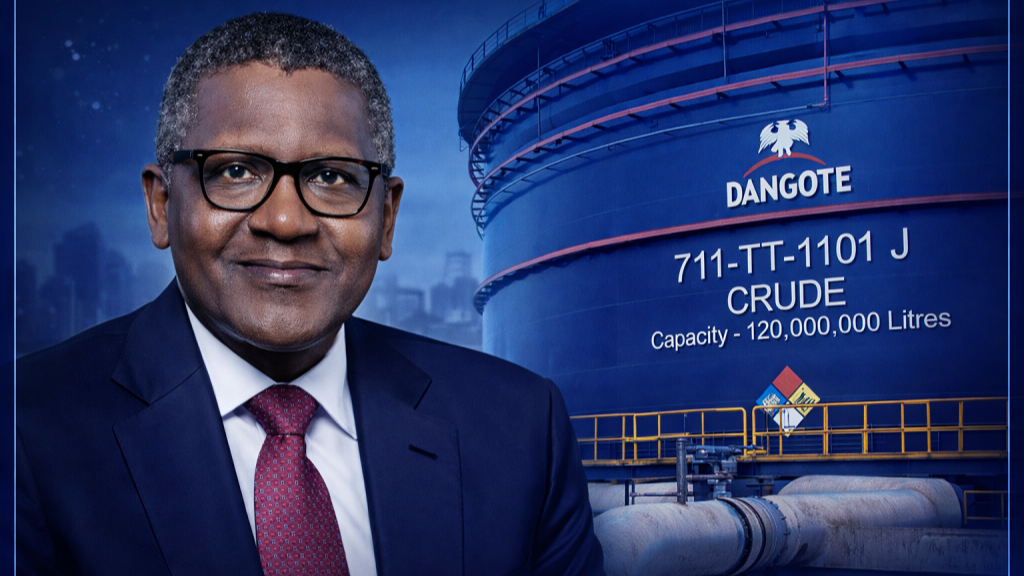
MONROVIA – Africa is witnessing a major moment in its financial and industrial history.
The launch of the Initial Public Offering (IPO) of Nigeria’s Dangote Petroleum Refinery and Petrochemicals is not simply another transaction on a stock exchange. It represents a significant test of Africa’s ability to mobilize domestic capital, expand industrial production and allow ordinary citizens to participate in the ownership of one of the continent’s most important industrial assets.
The IPO, launched in September 2026, is set to raise about ₦2.15 trillion, or approximately US$1.6 billion, through the sale of 4.1 billion shares. At ₦525 per share, the refinery is being valued at roughly ₦63 trillion, or about US$47.6 billion, making it Africa’s largest IPO to date.
But the importance of this transaction goes far beyond the numbers.
From exporting crude to producing value
For decades, one of Africa’s greatest economic contradictions has been that many African countries export crude oil and other raw materials while importing finished products made from those same resources. Nigeria has been one of the clearest examples.
The country is one of Africa’s largest oil producers, yet for years it depended heavily on imported refined petroleum products because of the poor performance of its state-owned refineries.
The Dangote Refinery is changing that equation.
The $20 billion facility, which began operations in 2024, has reached a processing capacity of about 700,000 barrels of crude oil per day. Its emergence has contributed to a dramatic reduction in Nigeria’s dependence on imported petroleum products while allowing the country to increase exports.
According to the U.S. Energy Information Administration, Nigeria’s seaborne petroleum-product imports fell from nearly 400,000 barrels per day in 2023 to less than 130,000 barrels per day in the second quarter of 2026. At the same time, petroleum-product exports increased substantially.
Africa needs more industries that take African raw materials and turn them into finished products on African soil.
The refinery is becoming an African energy supplier
The significance of the Dangote Refinery is not limited to Nigeria.
Its products are increasingly moving across African borders and into international markets.
In the second quarter of 2026, Nigeria exported nearly 120,000 barrels per day of petroleum products to other African countries, according to the U.S. Energy Information Administration.
That creates the possibility of a stronger regional energy market in which African countries increasingly source refined petroleum products from within Africa rather than depending almost entirely on suppliers outside the continent.
This matters because energy security is directly connected to economic development.
Factories need fuel. Airlines need jet fuel. Transport systems need diesel and petrol. Farmers need fertilizer. Businesses need reliable energy to produce and move goods.
When African countries are forced to import essential products from distant markets, they expose their economies to international price shocks, shipping disruptions and foreign exchange pressures.
A larger African refining industry can reduce some of these vulnerabilities.
The IPO: turning citizens into shareholders
Perhaps the most interesting dimension of the IPO is the attempt to broaden ownership.
The public offering allows retail investors to participate, with a minimum subscription of 10 shares, costing ₦5,250 at the offer price. Digital investment platforms are being used to make participation easier for Nigerians at home and abroad.
This introduces an important idea into Africa’s economic conversation:
African citizens should not only consume the products of African businesses; they should also have opportunities to own them.
For decades, ordinary Africans have watched large companies grow around them without necessarily having a direct stake in those businesses.
The Dangote IPO provides an opportunity to widen participation in capital markets and potentially bring new investors into the Nigerian stock market.
The Financial Times reported that the offering could attract millions of Nigerians who have never previously invested in the stock market.
That could have significance beyond Dangote.
A stronger culture of African citizens investing in African companies can help create deeper capital markets and provide African businesses with more avenues to raise money locally.
A model for African industrialization?
The greatest lesson from the Dangote Refinery may be the scale of ambition.
Africa has no shortage of natural resources.
What the continent has historically lacked is sufficient industrial capacity to process those resources domestically.
Oil is exported as crude.
Cocoa leaves Africa and returns as chocolate.
Minerals leave Africa as raw materials and return as finished industrial products.
Cotton can be exported and clothing imported.
The fundamental challenge is not simply what Africa possesses, but what it can produce.
Dangote’s refinery represents one attempt to change that model.
The refinery has demonstrated that a massive, privately financed industrial project can be built on African soil and compete in international markets. The Financial Times has described the project as an example of how African private capital and industrial ambition can contribute to reducing dependence on imports.
That does not mean the Dangote model is without debate. Questions have been raised about the refinery’s valuation, the level of Dangote’s continuing ownership and the relationship between large businesses and government policy. These issues deserve scrutiny as the company enters public markets.
But the broader industrial question remains important:
Can Africa build more companies capable of producing at continental and global scale?
The answer to that question could shape Africa’s economic future.
The next stage is even bigger
Dangote is not presenting the IPO as the end of the refinery’s journey.
The company intends to use the capital raised partly to support an expansion that would take refining capacity toward 1.4 million barrels per day over the coming years.
If achieved, that would place the refinery among the largest refining complexes in the world.
The company is already operating beyond Nigeria’s domestic market. Reuters reported that Dangote supplied significant volumes of jet fuel to Europe in the second quarter of 2026 while also increasing exports of diesel and gasoil to West Africa and Europe.
This demonstrates another important possibility: that Africa can become not only a supplier of raw materials to the world, but also a supplier of finished industrial products.
A message to African entrepreneurs
The Dangote Refinery story should also be viewed through the lens of African entrepreneurship.
Building a $20 billion refinery in Africa was a massive undertaking involving infrastructure, financing, engineering, logistics and years of risk.
Its emergence challenges the perception that Africa is only a destination for foreign companies extracting resources.
Africa needs foreign investment, but it also needs African capital capable of building African-owned companies at enormous scale.
From Lagos to Monrovia, Accra to Nairobi, Johannesburg to Cairo, African entrepreneurs and governments should be asking a fundamental question:
What can we produce here instead of importing it?
That question is at the heart of meaningful industrialization.
Dangote’s Proposed $15 Billion Kenya Refinery Enters Critical Stage as Ruto Pushes Towards Groundbreaking
Aliko Dangote’s ambitious expansion of Africa’s refining industry is moving into a decisive phase, with Kenya preparing to break ground on a proposed $15 billion refinery in Lamu that could fundamentally reshape the energy landscape of East Africa.
Kenyan President William Ruto has intensified efforts to move the project forward after meeting Dangote Industries President and Chief Executive Officer Aliko Dangote and Africa Finance Corporation CEO Samaila Zubairu in New York. Discussions focused on financing and final preparations for the project, with the groundbreaking scheduled for September 30, 2026.
The proposed refinery, with a planned processing capacity of 700,000 barrels of crude oil per day, is expected to be constructed within the LAPSSET Special Economic Zone in Lamu, near the deep-water Lamu Port. Kenyan authorities describe the development as a potential regional energy and industrial hub.
The scale is significant. At 700,000 barrels per day, the Kenyan facility would have a planned capacity greater than the original 650,000-barrel-per-day capacity of Dangote’s Nigerian refinery, which is itself being targeted for expansion to 1.4 million barrels per day.
A refinery designed for more than Kenya
Dangote’s Kenyan project is being positioned as a regional refinery, rather than a facility serving Kenya alone.
Once completed, the refinery is expected to supply petroleum products to Kenya and neighboring markets across East and Central Africa, potentially reducing the region’s dependence on imported refined fuel. Kenya currently spends billions of dollars importing petroleum products, making energy security a major economic consideration for Nairobi.
The Lamu location is strategically important
The facility will sit within the Lamu Port–South Sudan–Ethiopia Transport (LAPSSET) corridor, a major infrastructure project intended to connect Kenya’s coast with the landlocked economies of East Africa.
That creates the possibility of an industrial chain extending from the port to petroleum storage, transportation, petrochemicals, manufacturing and eventually agriculture.
Kenyan authorities also say the refinery is planned alongside a special economic zone and a 1,000-megawatt power plant, potentially transforming Lamu from a primarily coastal and tourism economy into a major industrial center.
Agriculture could become an important beneficiary
The implications extend beyond petrol and diesel.
A large refinery and petrochemical complex can produce or support industries supplying fertilizer and other agricultural inputs. That gives the project potential relevance to East Africa’s food-production ambitions.
The broader economic chain could look like:
Crude oil → refining → petrochemicals/fertilizer → agriculture → food production → agro-processing → regional trade.
For countries that currently import substantial quantities of agricultural inputs, developing production capacity closer to farmers could strengthen supply chains and reduce exposure to international disruptions.
This is where Dangote’s strategy becomes particularly significant: the company’s refining ambitions are increasingly connected to a wider industrial model involving energy, petrochemicals, fertilizer, agriculture and manufacturing.
Crude oil supply
Despite the project’s enormous potential, one of its biggest questions is where the refinery will obtain enough crude to operate at 700,000 barrels per day.
Kenya currently does not have commercial crude production anywhere near that level. Possible sources of crude include Kenya, Uganda and South Sudan, but each presents infrastructure or geopolitical challenges. Reuters has identified crude supply as one of the project’s major execution risks.
The LAPSSET corridor itself is expected to play an important role. However, some of the oil-storage infrastructure originally envisioned for Lamu has yet to be fully developed, meaning the refinery’s supply chain will require substantial investment.
Financing will be equally important
The estimated cost has been reported at between $15 billion and $16 billion, although some recent reports have placed the broader refinery and petrochemical investment considerably higher.
Dangote will also be competing for capital with other major projects. The financing structure could involve a combination of Dangote’s resources, debt, capital-market financing and participation by East African governments or investors.
There has nevertheless been a significant technical step forward: Engineers India Limited has secured a contract worth more than $450 million to provide project-management and engineering, procurement and construction-management services for the Kenyan refinery and petrochemical complex.
Lamu’s transformation
For Lamu itself, the refinery could become one of the largest industrial investments in the county’s history.
Kenyan officials have projected up to 10,000 direct jobs, with wider government and industry projections suggesting substantially larger employment effects when construction, suppliers, logistics and the surrounding economic zone are included.
From West Africa to East Africa
The Kenyan project represents something much larger in Dangote’s industrial strategy.
Nigeria is already home to Dangote’s giant refinery, whose planned expansion would take capacity to 1.4 million barrels per day. Kenya’s proposed 700,000-barrel-per-day facility would establish a major Dangote refining presence on Africa’s eastern coast.
Together, the planned capacities represent 2.1 million barrels per day.
That makes the Kenyan project more than another refinery. It is potentially the next major piece of Dangote’s ambition to build an African industrial supply chain capable of processing the continent’s raw materials and supplying finished products to African consumers.
A Pan-African opportunity
For Africa, the ultimate importance of the Dangote Refinery IPO may therefore not be the amount of money raised. It may be the precedent.
If African companies can build large industrial projects, list them on African exchanges, attract African investors, create employment, supply African markets and eventually compete globally, then the continent can begin to build a different economic structure.
One based less on exporting raw materials and more on production, processing, manufacturing, ownership and value creation.
The Dangote Refinery is Nigerian in ownership and location, but its implications are continental.
Its success or failure will be watched by investors, entrepreneurs, policymakers and businesses across Africa.
The IPO therefore represents more than a share sale.
It is a test of whether African capital markets can help finance African industrial ambitions.
And perhaps most importantly, it raises a question Africa can no longer avoid:
If Africa has the resources, the people and the markets, can Africans build the industries needed to transform those resources into lasting prosperity?
The Dangote Refinery has provided one answer.
The next chapter belongs to the rest of Africa.
How Can This Help Integrate Africa into One Market?
The Dangote Refinery can help integrate Africa into one African market by reducing the continent’s dependence on imported refined petroleum, fertilizer and petrochemical products.
Instead of African countries buying these essential products from outside the continent, they can increasingly source them from African producers such as Nigeria and, potentially, Kenya. This will strengthen cross-border trade, create demand for African transport and logistics networks, and encourage more investment in African industries.
More importantly, it can help move Africa from simply trading with one another to producing for one another.
Through AfCFTA, Nigeria’s industrial output can reach markets across West Africa, while Kenya can serve East Africa.
This creates interconnected supply chains, expands the market for African businesses and brings the continent closer to functioning as one integrated economic market of more than 1.3 billion people.
Dangote Refinery vs. SpaceX: Two Symbols of Industrial Ambition
The Dangote Industries refinery represents one of Africa’s biggest industrial investments, built at about US$20 billion, with capacity of around 700,000 barrels per day and plans to expand to 1.4 million barrels per day. Its IPO seeks about US$1.6 billion, giving the refinery an estimated valuation of roughly US$47.6 billion.
In the United States, SpaceX recently completed an IPO that raised approximately US$85.7 billion, with an implied valuation of about US$1.77 trillion. While SpaceX represents advanced aerospace technology and Dangote represents large-scale industrialization, both demonstrate how private capital can build enterprises of enormous economic importance.
For Africa, the bigger lesson is that industrialization requires African capital, African businesses and African markets working together.
Dangote’s expansion and the proposed refinery in Kenya could strengthen energy supply, manufacturing, trade and regional value chains, helping move Africa closer to becoming one integrated economic market.
Dangote’s Challenge to African Leaders
Dangote’s economic revolution presents African leaders with a clear challenge: create the environment where African businesses can build, produce and compete at global scale.
The refinery demonstrates what African private capital can achieve when ambition, investment and industrial capacity come together. The next step is for governments to provide the infrastructure, reliable energy, efficient ports, supportive policies, access to finance and regional trade systems needed to multiply such investments across the continent.
Businesses must invest, innovate, create jobs and build productive industries, while governments must provide the enabling environment and remove barriers that make production expensive and slow.
If these two stakeholders work together through AfCFTA and regional economic integration, Africa can move from exporting raw materials and importing finished goods to producing for Africans, trading more with Africans and exporting African-made products to the world.



No Comments
Join the DiscussionBe the first to join the discussion!