Why Ghana’s Interfaith Harmony Matters to Africa, and Why We Must Never Take It for Granted
“When the roots of a tree are deep, the wind does not easily uproot it.”
Ghana’s peace is such a tree.
Its branches are visible—in our elections, our markets, our schools, our mosques and churches, our homes and neighbourhoods. But its roots lie deeper, buried in generations of social interaction, religious coexistence, traditional authority, constitutional order, community relationships and the quiet wisdom of ordinary people who have learned, sometimes without ever putting it into words, that the neighbour who prays differently is still a neighbour.
That is why Ghana’s religious harmony deserves more than applause.
It deserves understanding.
It deserves protection.
And, perhaps most importantly, it deserves to be studied as a form of African social capital.
Across parts of Africa, religious difference has become entangled with political exclusion, economic deprivation, communal distrust, weak institutions, insecurity and violent extremism. In the Sahel, violence has crossed borders and destabilised communities. In northeastern Nigeria, extremist organisations have inflicted enormous suffering. In Somalia, Al-Shabaab has demonstrated how violent movements can exploit prolonged insecurity and weak state authority. In the Central African Republic, political conflict became deeply entangled with religious identity, producing devastating communal violence and displacement.
Ghana, by contrast, has remained comparatively stable.
But we must be careful with our language.
Ghana is not an island untouched by tension. Ghana is not a utopia. Ghana has political disagreements, chieftaincy disputes, communal conflicts, social inequalities and occasional moments of religious friction.
Its achievement is something more practical—and perhaps more profound.
Ghana has repeatedly demonstrated an ability to live with difference without allowing difference to become destiny.
That is the story worth telling.
And that is the shield we must never allow to crack.
THE ROOTS OF A SHARED AFRICAN STORY
Africa’s religious landscape is older, more complicated and more African than the simplistic narratives sometimes imposed upon it.
Islam travelled deeply into West Africa through trans-Saharan commerce, scholarship, migration, intermarriage and political networks. Christianity, too, possesses ancient African roots reaching back to the earliest centuries of the faith, particularly in North Africa and Egypt, long before European colonialism.
Much later, European missionary activity and colonial power dramatically expanded Christianity across large parts of sub-Saharan Africa, sometimes through education and persuasion, sometimes alongside political coercion and colonial structures.
The history of both religions on African soil is therefore neither entirely a story of peaceful arrival nor entirely a story of foreign imposition.
It is a story of encounter.
Africa encountered these faiths.
Africans interpreted them.
Africans resisted aspects of them.
Africans reshaped them.
Africans became their scholars, theologians, pastors, priests, imams and missionaries.
And over generations, both Christianity and Islam became deeply embedded in the social, cultural and political life of millions of Africans.
This matters because religious identity in Africa can no longer be understood through the crude lens of “foreign” versus “African.”
Christianity and Islam have both undergone profound Africanisation.
They have been spoken in African languages, expressed through African music, incorporated into African family structures, practised alongside indigenous cultural traditions and interpreted by African intellectuals and religious authorities.
The story, therefore, is not simply that two foreign religions arrived and replaced Africa.
The deeper story is that Africa encountered two world religions and, in the process, transformed them into African lived realities.
That history should make religious hostility among Africans all the more tragic.
DIFFERENT FAITHS, SHARED HUMANITY
Christianity and Islam are not identical.
Their doctrines differ. Their sacred texts differ. Their theological understandings differ.
But they are not strangers standing on opposite ends of human history.
Both belong to the Abrahamic family of religions and share important historical and ethical connections. Abraham, Moses and Jesus occupy significant places in both traditions. Both traditions speak extensively about justice, charity, compassion, family responsibility, moral conduct and the dignity of human life.
Their differences are real.
But difference does not have to become enmity.
A Muslim does not have to become a Christian before the Christian can recognise his humanity.
A Christian does not have to become a Muslim before the Muslim can defend her dignity.
And neither needs to abandon his or her faith in order to share a country, a neighbourhood, a marketplace, a school or a national destiny.
Peace does not require theological sameness. It requires human recognition.
This is where Ghana offers such a compelling example.
The question has never been whether Christians and Muslims can erase their differences.
They cannot.
And they should not have to.
The question is whether those differences can live beside one another without becoming weapons.
So far, Ghana has repeatedly answered:
Yes.
A COUNTRY WHERE DIFFERENCE LIVES NEXT DOOR
Imagine a Ghanaian neighbourhood at dawn.
From one compound comes the call to prayer.
From another, someone is preparing for church.
A trotro rattles noisily along the road.
A woman sweeps the frontage of her house.
A shopkeeper lifts his shutters.
A Muslim father takes his child to school.
A Christian mother buys breakfast from a Muslim vendor.
Nobody stops to hold a conference about coexistence.
Nobody writes a communiqué.
Nobody signs a peace agreement.
Life simply happens.
And that may be one of the greatest secrets of Ghanaian peace.
Peace is not always created in conference halls.
Sometimes it is created at the market stall.
At the school gate.
At the funeral.
At the football field.
At the naming ceremony.
At the roadside chop bar.
At the neighbour’s wedding.
At the moment when one family sends food to another during Eid, and the gesture is returned during Christmas.
These acts rarely make international headlines.
But nations are not held together only by constitutions and security forces but by our implicit, subtle societal mores. Sometimes not built by cement but by equally strong, rather implicit, subtle language.
They are also held together by habits.
And Ghana has developed habits of coexistence.
The strongest bridge between two communities is sometimes not built with concrete.
It is built with familiarity.
The person whose religion you understand is harder to turn into a stranger.
The person whose family has eaten at your table is harder to turn into an enemy.
The neighbour whose child went to school with yours is harder to demonise.
That is social cohesion in its most ordinary—and most powerful—form.
THE AFRICAN WAY OF UNDERSTANDING PEACE
African societies have long understood something modern politics sometimes forgets:
a community is not merely a collection of individuals. It is a web.
Pull one strand and the vibration travels through the entire fabric.
This is why the Akan wisdom, “Nsa baako nkura adesoa”—one hand cannot lift a heavy load—means far more than physical labour.
Peace itself is a communal load.
No government can carry it alone.
No police service can carry it alone.
No imam can carry it alone.
No pastor can carry it alone.
No traditional ruler can carry it alone.
No peace council can carry it alone.
The burden must be lifted together.
Another widely remembered African wisdom says:
“If you want to go fast, go alone; if you want to go far, go together.”
For Ghana, the lesson is especially relevant.
The country did not become stable because everyone began thinking alike.
It became stronger because different communities learned that they needed one another.
That is a profoundly African idea.
And perhaps one of the most powerful antidotes to extremism.
GHANA’S GREAT EXPERIMENT: DIFFERENCE WITHOUT ENMITY
There is a profound difference between tolerance and belonging.
Tolerance says:
“I will allow you to exist.”
Belonging says:
“Your existence is part of the society to which I also belong.”
Ghana’s strongest interfaith moments belong to the second category.
Muslim and Christian communities are not merely parallel populations.
They intersect.
They trade together.
They work together.
They study together.
They participate in one another’s national life.
And religious leaders have repeatedly used their influence to communicate that religious difference need not produce national division.
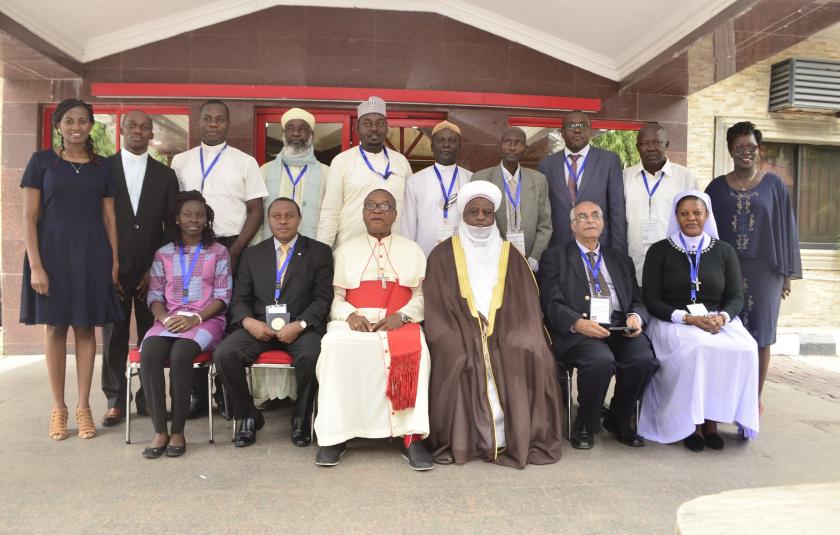
The public example of National Chief Imam Sheikh Dr Osman Nuhu Sharubutu’s engagement with Christian leaders has become emblematic of this tradition.
Such moments matter because symbols speak to populations in ways policy documents sometimes cannot.
When a Muslim leader enters a Christian sacred space in friendship, the image travels beyond the room.
It tells a child watching:
“Your neighbour’s faith is not your enemy.”
When Christian leaders publicly stand beside Muslim leaders, the message is repeated.
When ordinary families share food across religious boundaries, the message becomes everyday reality.
And when the law protects citizens impartially, regardless of creed, the message becomes institutional.
That is how a culture of peace is built:
symbol by symbol, relationship by relationship, generation by generation.
THE THREE SHIELDS OF GHANAIAN PEACE
Ghana’s experience can perhaps be understood through three overlapping shields.
The First Shield: Social Familiarity
People know one another.
They live beside one another, trade together, attend one another’s ceremonies and participate in one another’s lives.
Familiarity humanises difference.
The Second Shield: Institutional Mediation
When relationships fail, institutions provide somewhere for disagreement to go.
Dialogue.
Mediation.
Reconciliation.
The National Peace Council represents an important part of this architecture.
The Third Shield: Constitutional Neutrality
When dialogue cannot resolve an issue, the law must.
Not Christian law.
Not Muslim law.
Not the law of the majority.
The law of the Republic.
This threefold structure is critical:
Culture → Institution → Law.
The culture prevents unnecessary hostility.
The institution provides a peaceful mechanism when relationships strain.
The law prevents disagreement from becoming religious retaliation.
That is the shield.
WHEN WISDOM BECOMES INSTITUTION
There is a Ghanaian proverb that says:
“The old woman watches the road because she has seen the road before.”
The wisdom of experience is one of Africa’s great resources.
But wisdom becomes even more powerful when a nation gives it institutional form.
Ghana did precisely that through the establishment of the National Peace Council under the National Peace Council Act, 2011 (Act 818).
Its role in preventing, managing and resolving conflict and promoting sustainable peace through mechanisms including mediation, dialogue and reconciliation is a critical part of Ghana’s national peace architecture.
This matters enormously.
Because when a society has no mechanism for disagreement, disagreement searches for its own mechanism.
Sometimes that mechanism is dialogue.
Sometimes it is the courtroom.
Sometimes it becomes a street protest.
And in the worst circumstances, it becomes violence.
Ghana’s peace architecture provides somewhere else for grievances to go:
to the table.
A table is one of humanity’s oldest instruments of peace.
People who are angry sit opposite one another.
They talk.
They argue.
They listen.
And sometimes, slowly, they discover that what separates them is smaller than what they share.
THE PEACE ECONOMY: WHY HARMONY IS ALSO INFRASTRUCTURE
We routinely call roads, bridges, ports, electricity grids, railways and telecommunications infrastructure.
We should begin speaking about peace in the same language.
A road allows goods to move.
Peace allows people to move.
A port allows commerce to enter.
Peace allows commerce to remain.
Electricity allows businesses to operate.
Peace gives businesses the confidence to invest.
A telecommunications network connects people across distance.
Peace allows those connections to remain relationships rather than becoming channels of mobilisation for hatred.
Consider the trader who crosses a neighbourhood every morning without wondering whether the person behind the counter is Christian or Muslim.
Consider the tourist who arrives in Accra and travels to Tamale without expecting a religious conflict to interrupt the journey.
Consider the investor who sees political disagreements but does not automatically expect those disagreements to become sectarian warfare.
Consider the student who goes to school rather than a refugee camp.
Consider the farmer who plants because he expects to return to harvest.
These things have economic value.
The greatest economic value of peace is often invisible.
It is the business that never closed.
The school that never shut.
The road that remained open.
The tourist who still came.
The investor who still signed.
The child who never had to flee.
That is the dividend of peace.
Peace is therefore not merely the absence of war.
Peace is productive infrastructure.
And like every form of infrastructure, it requires maintenance.
THE LESSON FROM THE SAHEL
Now look north.
The Sahel offers Ghana a warning written not merely in reports but in displacement, destroyed communities, disrupted economies and empty classrooms.
Mali, Burkina Faso and Niger have experienced prolonged insecurity involving jihadist organisations and other armed actors.
The causes are complex.
Religion alone does not explain the crisis.
Neither does poverty.
Neither does ethnicity.
Neither does weak governance.
But when these conditions converge, they can create fertile ground for violent movements.
This is where Ghana must pay attention.
An extremist does not always enter a community through the mosque or the church.
Sometimes the extremist enters through a grievance.
Through unemployment.
Through humiliation.
Through injustice.
Through marginalisation.
Through the feeling that government exists somewhere else.
Through the belief that nobody listens.
The gun may come later.
The narrative often comes first.
That is why Ghana’s peace must not be defended only at the border.
It must be defended inside the social fabric.
Recent regional security developments demonstrate that violent extremist networks operating in the Sahel continue to possess ambitions and reach that extend beyond their immediate theatres of operation.
Geographical distance should therefore never create psychological distance.
The fire may be across the river today.
Tomorrow, the wind may change.
THE NORTHERN GHANAIAN QUESTION
Ghana’s northern communities deserve particular attention.
Not because they are inherently vulnerable.
They are not.
But because geography places them closer to regional security pressures emerging from the Sahel.
And because border communities are not abstract lines on a map.
They are human communities.
Families may have relatives across borders.
Traders cross frequently.
Cultural and ethnic relationships often predate modern national boundaries.
Religious identities cross frontiers.
This means the border is simultaneously a security frontier and a human space.
Ghana must therefore resist the temptation to treat northern communities merely as potential security threats.
They must be treated as partners in national security.
That means investing in:
- education;
- employment;
- infrastructure;
- youth programmes;
- women-led peacebuilding;
- community policing;
- traditional authorities;
- religious leadership;
- local early-warning systems; and
- meaningful economic opportunity.
A community that believes it belongs to the nation is harder for an extremist to persuade that the nation has abandoned it.
Therein lies one of the deepest principles of preventive security:
Belonging is a form of defence.
An interfaith dialogue training in Tumu in 2026, bringing together religious leaders, youth and women leaders and other stakeholders around local peacebuilding and resilience, illustrates the kind of grassroots approach that Ghana should deepen.
Because the people who know where the grass is beginning to move are usually the people who live beside the grass.
NIGERIA: A NEIGHBOURING MIRROR
Then there is Nigeria.
Ghana and Nigeria are neighbours not merely geographically but culturally.
Our histories overlap.
Our economies are intertwined.
Our peoples cross borders.
Our religious landscapes contain enormous Christian and Muslim populations.
Yet Nigeria has experienced forms of religiously framed violence on a scale Ghana has so far avoided.
Boko Haram and ISWAP have devastated communities in northeastern Nigeria.
But Nigeria must not be reduced to extremism.
Millions of Nigerian Muslims and Christians reject violence, and religious leaders continue to build mechanisms for interfaith cooperation.
That distinction matters.
Ghana should never look at another African country and say:
“That could never happen here.”
The wiser African response is:
“What happened there, and what can we learn before our own warning signs become flames?”
A wise farmer does not wait for his neighbour’s farm to burn before clearing the dry grass around his own.
CENTRAL AFRICA’S SOBERING LESSON
The Central African Republic offers another warning.
There, conflict involving Seleka and Anti-Balaka forces became deeply entangled with religious identity.
The tragedy was not that Christians and Muslims suddenly discovered that they were different.
They have always been different.
The tragedy was that political and armed actors transformed those differences into instruments of mobilisation.
That is the danger.
Religion becomes dangerous to peace not simply when people believe strongly.
It becomes dangerous when identity is weaponised.
Once that happens, the individual disappears behind the label.
A man who commits a crime becomes “the Muslim.”
A militia becomes “the Christian community.”
A political grievance becomes “religious conflict.”
And then an entire population begins paying for the actions of individuals.
Ghana must resist that logic with everything it has.
SOMALIA: WHEN THE STATE LOSES THE ARGUMENT
Somalia offers another warning.
Al-Shabaab has demonstrated the destructive capacity of a violent extremist organisation operating within conditions of prolonged instability.
The lesson for Ghana is not simply to increase military preparedness.
Security is essential.
But soldiers cannot permanently manufacture social trust.
A soldier can protect a village.
He cannot, by himself, create a relationship between that village and the state.
A police officer can arrest a suspect.
He cannot, by himself, create a sense of belonging.
A court can deliver judgment.
It cannot single-handedly repair every broken social relationship.
That work belongs to society.
And that is why Ghana’s religious leaders, chiefs, educators, women and young people are not peripheral to national security.
They are part of its foundation.
THE THREAT THAT FITS INSIDE THE PALM OF THE HAND
There is, however, a new frontier.
It fits inside the palm of the hand.
The smartphone.
A rumour once needed a human voice.
Now it needs only a finger.
A lie can cross Accra before breakfast.
A provocative message can reach Tamale before midnight.
An old photograph can be presented as a new attack.
A video can be edited.
A quotation can be fabricated.
And by the time truth wakes up, falsehood may already have travelled halfway across the country.
This is the new challenge to Ghanaian peace.
The algorithm does not understand community harmony.
It does not understand religious sensitivity.
It does not understand the consequences of a lie spreading through a frightened population.
It knows what attracts attention.
And anger attracts attention.
That means Ghana’s traditional peace architecture must now enter the digital age.
THE DIGITAL SHIELD
Ghana should develop a national interfaith early-warning and rapid-response mechanism connecting the National Peace Council, religious bodies, security institutions, traditional authorities, civil society, media organisations and digital-information specialists.
Its purpose should not be to police religion.
Its purpose should be to protect society from the acceleration of misinformation into violence.
Imagine this scenario.
A provocative religious video begins spreading at 8:00 p.m.
By 8:30, thousands have seen it.
By 9:00, angry commentary begins appearing.
By 10:00, rumours circulate that a religious community is preparing retaliation.
By midnight, frightened parents are calling relatives.
The old system waits until morning.
The new system cannot.
It needs trusted religious leaders who can immediately say:
“Remain calm. We are verifying this.”
It needs peace institutions capable of contacting affected communities.
It needs police able to distinguish genuine threats from online noise.
It needs journalists who verify before broadcasting.
It needs technology companies to respond responsibly to dangerous misinformation.
In other words:
Ghana needs a digital version of the village elder who hears the first rumour and says, “Let us sit down before we run.”
WHEN FAITH BECOMES A WEAPON
There is another danger.
The most destructive religious conflict often does not begin with a battlefield.
It begins with language.
An insult by one individual becomes an accusation against an entire faith.
A criminal act becomes the responsibility of millions.
A political grievance acquires a religious label.
A careless sermon becomes a viral clip.
A fabricated photograph becomes “evidence.”
A rumour becomes certainty.
And suddenly, people who have traded together for generations begin looking at one another as enemies.
Africa has seen this transformation before.
The lesson is not that Islam causes violence.
Nor is it that Christianity causes violence.
Such claims would be historically and intellectually reckless.
The deeper lesson is that religious identity can be weaponised by political actors, extremist organisations and opportunists when combined with grievance, exclusion, insecurity and institutional weakness.
The problem is not the existence of faith.
The problem is the weaponisation of faith.
THE AFRICAN WARNING: NO FAITH SHOULD BECOME A WEAPON AGAINST THE NATION
This is where the broader African conversation becomes important.
African leaders and thinkers have increasingly warned against allowing religious identity to become stronger than national and human solidarity.
Captain Ibrahim Traoré of Burkina Faso has, in public discourse, been associated with the argument that religious identity must not be permitted to destroy national unity, including the principle that no religious identity should stand above the nation.
A Muslim, Christian or follower of an African traditional religion remains first and foremost a human being, a member of a community and a citizen whose dignity cannot be surrendered to sectarian mobilisation.
There is a profound moral contradiction in invoking God to justify the destruction of another human life.
The theological traditions may differ in their language, but the moral question is universal:
How can a human being claim to defend the Author of life by casually destroying the life he did not create?
This is why religious tolerance is not weakness.
It is moral discipline.
THE ECONOMICS OF PEACE
Peace is not merely spiritual virtue.
It is economic infrastructure.
A peaceful Ghana allows a trader to travel.
It allows a tourist to explore.
It allows a farmer to cultivate.
It allows a student to attend school.
It allows an investor to plan.
It allows a hospital to function.
It allows a family to sleep.
We often calculate the cost of violence only after violence arrives.
We count destroyed buildings.
Lost businesses.
Displaced families.
Security expenditure.
Lost school days.
Lost investment.
But the greatest economic value of peace is often invisible.
It is the business that never closed.
The school that never shut.
The road that remained open.
The tourist who still came.
The investor who still signed.
The child who never had to flee.
That is the dividend of peace.
Peace is therefore not an ornamental virtue that governments protect when convenient.
It is productive capital.
GHANA MUST NOT BECOME COMPLACENT
But there is a danger hidden inside Ghana’s success.
Familiarity can produce carelessness.
A generation born into peace may assume that peace is natural.
It is not.
Peace is cultivated.
Like a farm.
Like a marriage.
Like a friendship.
Like a garden.
If nobody waters it, weeds grow.
If nobody protects it, animals enter.
If nobody repairs the fence, the boundary disappears.
The fact that Ghana has maintained relative religious harmony for generations does not guarantee that the next generation will.
Every generation must inherit not merely peace itself, but the wisdom required to maintain it.
THE GHANAIAN YOUNG PERSON IS THE REAL FRONTLINE
We often speak about young people as if they are merely potential victims of extremism.
That is too narrow.
Young people are also Ghana’s greatest peacebuilders.
They move rapidly between communities.
They are deeply immersed in digital communication.
They can either amplify hatred or dismantle it.
A young Ghanaian Muslim who refuses to share a hateful message is performing an act of peace.
A young Christian who challenges an anti-Muslim joke is performing an act of peace.
A young person who refuses to turn another person’s religion into an insult is performing an act of peace.
These actions rarely make headlines.
But they are how societies survive.
The peace of tomorrow may depend less on the speeches delivered by today’s leaders than on the choices made by millions of young people when nobody is watching.
EDUCATION MUST TEACH MORE THAN EXAMINATIONS
Ghana should therefore deepen religious and civic literacy.
A child should understand not only what his or her own tradition teaches, but also that the neighbour’s tradition is not automatically a threat.
Schools can teach:
- religious literacy;
- constitutional rights;
- peaceful disagreement;
- misinformation awareness;
- conflict resolution;
- African traditions of communal responsibility;
- the history of Ghanaian interfaith cooperation; and
- the dangers of religious stereotyping.
This is not about turning schools into theological institutions.
It is about teaching children how to inhabit a diverse nation.
Because ignorance creates fear.
Understanding creates familiarity.
And familiarity is one of the quiet enemies of extremism.
THE AFRICAN IDEA OF UBUNTU
The Southern African concept of Ubuntu offers language for something Ghana has long practised in its own ways:
I am because we are.
It reminds us that identity is relational.
You cannot injure the community without eventually injuring yourself.
The Akan world expresses related wisdom through communal responsibility.
Across Africa, similar philosophical truths appear in different languages:
the individual exists inside the community.
That is precisely what violent extremism tries to destroy.
It tells the young person:
“Your neighbour is your enemy.”
Ghana must answer:
“Your difference does not cancel your belonging.”
GHANA’S PEACE MUST BECOME A PAN-AFRICAN RESOURCE
This is where the Ghanaian story becomes larger than Ghana.
Ghana should not export the message:
“We are better than the rest of Africa.”
That would be neither wise nor Pan-African.
Ghana should export a more humble question:
“What have we learned about living with difference that might help another African society?”
That is a far more powerful form of African leadership.
Ghana could champion an ECOWAS interfaith peace framework.
It could strengthen regional early-warning networks.
It could train peace practitioners.
It could facilitate exchanges among religious leaders.
It could create exchanges among communities living along vulnerable borders.
It could document successful local peace interventions.
It could contribute to a regional database of social-cohesion practices.
It could develop stronger measures of social trust and interfaith resilience.
And, ultimately, Ghana could transform its experience into a body of African knowledge about peace.
Because Africa does not need imported answers to every African problem.
Sometimes the wisdom is already here.
We simply have not organised it.
THE KENTE OF THE REPUBLIC
Think again of kente.
Its beauty comes from difference.
Gold does not surrender its goldness.
Green does not surrender its greenness.
Blue does not become red.
The threads remain themselves.
But when woven together, they create something none could create alone.
That is what Ghana must protect.
Not sameness. Togetherness.
Not uniformity. Harmony.
Not the absence of difference. The peaceful management of difference.
Pull one thread hard enough, and the entire cloth feels the strain.
That is what religious intolerance does.
An insult becomes anger.
Anger becomes suspicion.
Suspicion becomes segregation.
Segregation becomes hostility.
Hostility becomes confrontation.
And confrontation can become violence.
The wiser course is to repair the thread while the cloth is still whole.
THE AFRICAN FIRE
Imagine a village at night.
A small fire burns beside a house.
It is only a flame.
Someone notices it.
They pour water.
Another person brings sand.
A third person wakes the neighbours.
Within minutes, the danger is gone.
Now imagine the same fire ignored.
The wind rises.
The dry grass catches.
The roof catches.
The next house catches.
Soon everyone is running.
The difference between the two scenarios is not the fire.
It is the response time.
That is Ghana’s challenge.
Religious tension will occasionally appear.
Political tension will appear.
Misinformation will appear.
Communal grievances will appear.
The objective is not to create a society in which no spark ever occurs.
That is impossible.
The objective is to build a society that knows how to extinguish the spark before the bush catches fire.
THE GHANAIAN CALABASH
There is another image that may be even more appropriate.
Imagine the great African calabash.
A village gathers around it.
Water is drawn from it.
Food is carried in it.
People depend upon it.
But a small crack appears.
At first, the crack seems harmless.
Someone says:
“It is only a little crack.”
Another says:
“We have used this calabash for years.”
Another says:
“It has never broken before.”
But the crack remains.
Water enters.
The pressure increases.
The crack widens.
Eventually, what could have been repaired with a little care becomes impossible to ignore.
That is how nations sometimes lose peace.
Not in one dramatic moment.
But through thousands of neglected cracks.
A careless word.
A tolerated prejudice.
A fabricated rumour.
An irresponsible sermon.
A political manipulation.
An unresolved grievance.
A young person who feels abandoned.
A community that feels forgotten.
A justice system perceived as selective.
The crack begins small.
The wise society repairs it while it is still small.
WHAT GHANA MUST DO NOW
Ghana should therefore strengthen five areas simultaneously.
First: Protect the institutions of peace
The National Peace Council and regional and district peace structures must possess the resources, independence and capacity necessary to intervene before crises become emergencies.
Second: Strengthen permanent interfaith communication
Christian, Muslim and traditional leaders should maintain permanent channels of communication rather than waiting until a crisis erupts.
The best time to build a bridge is before the flood.
Third: Invest in northern and border communities
Security must be accompanied by economic opportunity, education, infrastructure, youth development, women-led peacebuilding and meaningful local participation.
A citizen who feels seen by the state is less easily persuaded that the state has abandoned him.
Fourth: Build digital peace infrastructure
Ghana must learn to detect and respond rapidly to misinformation, fabricated content, hate speech and inflammatory narratives before they acquire communal momentum.
Fifth: Teach the next generation how to live with difference
Peace must become part of civic education, not something discussed only after violence has begun.
THE FINAL WARNING
The greatest danger to Ghanaian peace may not arrive wearing the uniform of an extremist organisation.
It may arrive as a sentence.
A rumour.
A manipulated video.
A careless sermon.
A political speech.
A fabricated photograph.
A lie forwarded by someone who never intended harm.
That is why every Ghanaian has become, in some small way, a guardian of the national peace.
The policeman.
The imam.
The pastor.
The chief.
The teacher.
The journalist.
The politician.
The student.
The trader.
The mother.
The young person holding a smartphone.
Everybody is holding a piece of the shield.
And if one person drops his piece, another must be ready to lift it.
THE SHIELD MUST NEVER CRACK
Ghana’s religious harmony is not a museum piece from a gentler past.
It is living infrastructure.
It is being built every day—in mosques and churches, markets and schools, homes and workplaces, in the words of religious leaders and in the ordinary kindness of neighbours.
Across Africa, the consequences of broken social trust can be seen.
The Sahel reminds us what happens when insecurity, grievance and extremism feed upon one another.
Nigeria reminds us that a vast, religiously diverse democracy requires constant investment in interfaith trust.
The Central African Republic reminds us how dangerous it becomes when political conflict weaponises religious identity.
Somalia reminds us what extremist organisations can accomplish when state authority and social resilience weaken.
But Ghana should look at these experiences not with arrogance.
With wisdom.
The wise farmer does not mock the neighbour whose farm has burned.
He studies the direction of the wind.
He clears the grass around his own farm.
He checks the roof.
And he keeps water close.
That is what Ghana must do.
We must preserve the relationships that have carried us this far.
We must strengthen the institutions that turn conflict into dialogue.
We must protect our northern communities.
We must invest in our young people.
We must make our digital spaces less vulnerable to manipulation.
We must defend impartial justice.
We must teach every new generation that religious difference is not a crack in the national wall.
It is part of the architecture of Ghana itself.
And Ghana’s responsibility extends beyond its borders.
If Ghana can demonstrate that Christianity and Islam can remain distinct without becoming hostile; that traditional authority can coexist with constitutional democracy; that religious identity can coexist with national identity; and that disagreement can be managed without violence, then Ghana offers something far more valuable than a story of domestic success.
It offers an African possibility.
Not a perfect model.
Not an infallible model.
But a living one.
A model that says the continent does not have to choose between diversity and peace.
A model that says religious conviction does not require religious hostility.
A model that says the neighbour’s difference can coexist with one’s own dignity.
A model that says peace is not weakness.
Peace is strength organised.
Peace is social capital.
Peace is economic infrastructure.
Peace is national security.
Peace is an inheritance.
And like every inheritance, it can either be preserved or squandered.
For Ghana’s future—and perhaps for West Africa’s future—the question is not whether storms will come.
They will.
The question is whether the house will remain standing when they do.
The question is whether the roots will remain deep.
Whether the threads will remain woven.
Whether the calabash will remain whole.
Whether the people will remember that the water belongs to everyone.
And whether, when the first spark appears in the darkness, somebody will still have the wisdom to reach for the water before the wind arrives.
Because a nation is not made strong by eliminating its differences.
It is made strong by learning how to carry them together.
And perhaps that is the wisdom we should leave with the next generation:
“When the drumbeat changes, the wise dancer does not abandon the dance; he listens more carefully, finds the rhythm, and keeps the people together.”
For the wind will come.
The storms will test the tree.
The fire will sometimes appear.
But when the roots are deep, the threads are woven, and the people hold the shield together, the wind may bend the nation, but it will not uproot it.
That is the peace Ghana must protect. That is the shield Africa must learn to strengthen.



No Comments
Join the DiscussionBe the first to join the discussion!